
Happy Ten Year Anniversary to My Most Beloved OC
11.14.26 // 1:00pm
I’ll be real: life hasn’t been awesome lately. I just lost my 21-year-old cat, Maybe, who’s been slowly failing over the past month. My mom was in the hospital for a week. I’m dealing with a lot of stressors, to the point where I can’t even engage with hobbies that I like. Even so, I don’t want to write a sad blog post—I have done that before, and I found that it wasn’t very helpful. Perhaps such topics would be better covered in a private diary, eh?
Anyway, this month, I wanted to ramble about one of my OCs, Amezi Goldenscale. It’s coming up on Amezi’s tenth anniversary! I don’t have the exact date, but I first created them in either 2016 or 2017—sometime during college. Over the years, Amezi has changed and evolved a lot, alongside and in contrast to my own self… so I thought, why not recount their different iterations and how they’ve changed for this November blog?
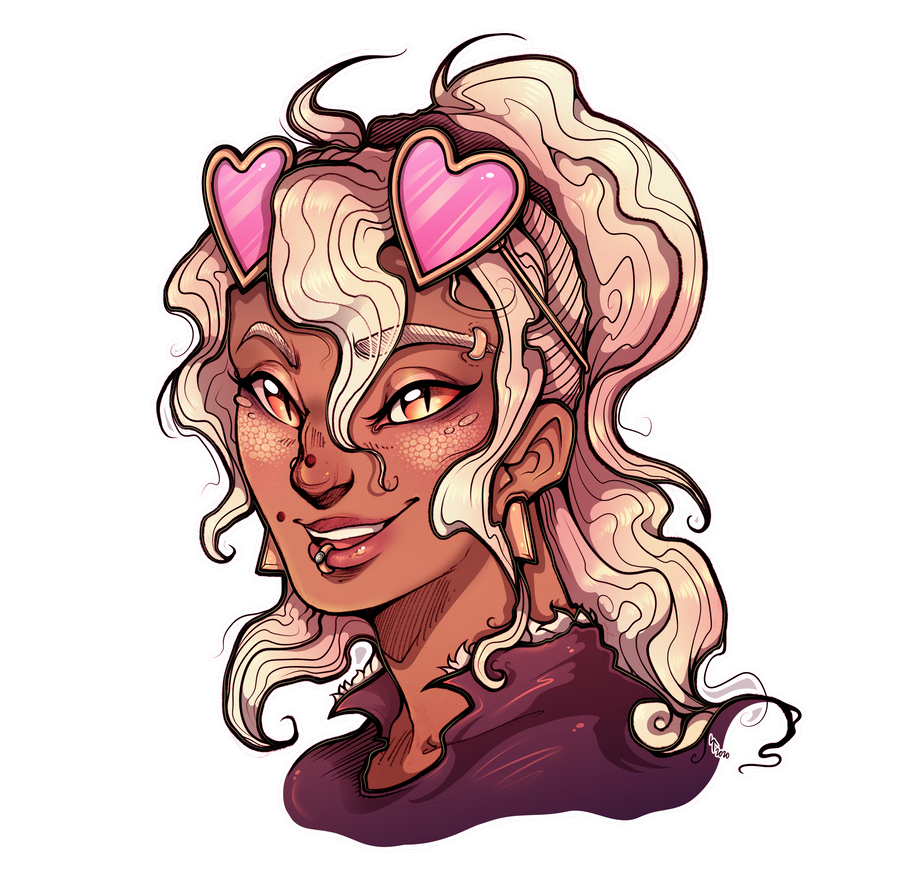
My creature! Art by sharkyshon.
Amezi was originally created as Amezi Goldenscale, yuan-ti pureblood, College of Glamour bard. I made them for a D&D group I played with in college in an Eberron setting. That group was fun, but… it did eventually fizzle out due to interpersonal drama. We started with an Out of the Abyss campaign (where I played a personalityless tiefling Redemption paladin named Candor), then decided to move to Eberron because everybody kind of hated the Underdark.
The drama involved the players out of game. The DM was, like, some sort of pathological liar who begged me to watch his apartment while he was away over the summer… but one of the other players said that he wanted her to watch the apartment? It didn’t really matter to me either way, but it was bizarre that he couldn’t make a decision—and the other girl was mad at me. Maybe she was the liar? I dunno—nobody could get their story straight, and it was so insane that I wound up cutting everybody off. Also, I lent the DM a chair that I asked for back when he was moving, and he claimed it wasn’t mine… I had to turn it over and point to my friend’s name written on the bottom, as it was a chair she had given me, like, five years prior.
Anyway, that’s neither here nor there. I created Amezi as a glamour bard with the major pitch being, “What if ‘glamour’ meant ‘glam rock’?” And the rest is history. Around that time, I read some sort of Tumblr post about how you’ll have way more fun if your D&D characters are repurposed canon characters you like, so I thought I’d give it a go: I based a lot of Amezi on the character Klavier Gavin from Ace Attorney. If you held a gun to my head and asked me who my favorite character of all time was, I’d probably say Klavier. He’s been grandfathered into the position, having been my fictional obsession since the year 2009.
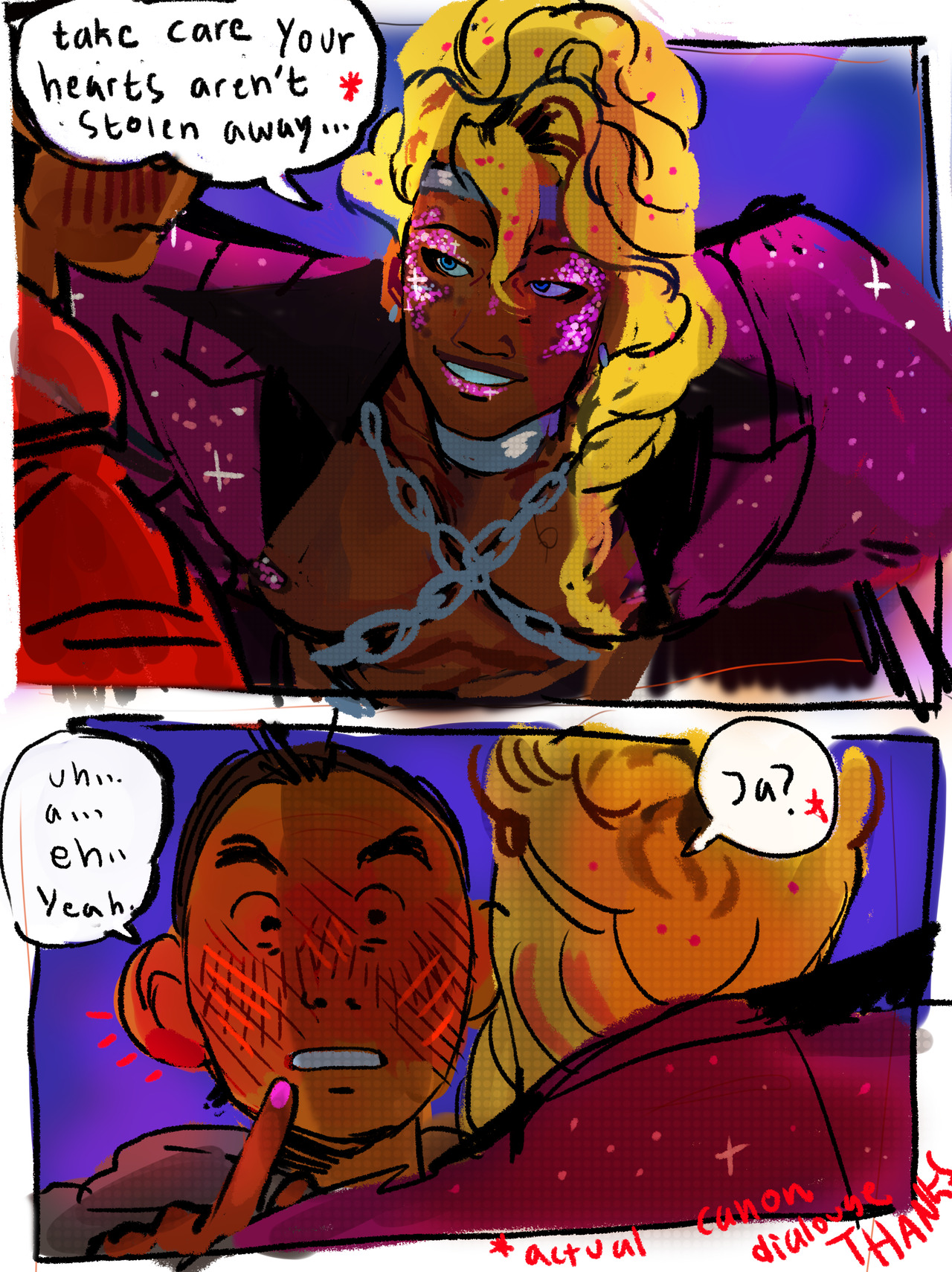
This specific picture of Klavier, drawn by an artist on Tumblr I can’t find, really inspired me. Replace the purple glitter with gold, and that is Amezi. I’ve had this saved to my tablet for years.
Even so, Amezi resembles Klavier in appearance only. I don’t know what the hell I was thinking bringing this to a game with people I didn’t know super well, but the original Amezi backstory was loaded with sexual trauma. I was reading The Tale of Genji in my Japanese classical literature class, and it was so difficult to get through that it was taking up pretty much all of my spare time. Thus, courtesans and trauma were on the mind. The backstory was, in as few words as possible: after a childhood spent on the streets, Amezi was taken in by the lord of a Dragonmarked House who kept him locked up with a bunch of other poet-y/musical courtesans for a handful of years, occasionally lending him out to political guests. While in this servitude, Amezi became friends with an elf named Shallaya who taught him the basics of fey glamour and song. He eventually escaped, became an adventurer, yadda-yadda—the point is, this version of Amezi was strongly and strictly characterized by his rage.
He was angry at Dragonmarked Houses, a large establishment in the setting of Eberron—essentially magical, bloodline royalty. He was angry at all royalty/bourgeoisie, as his abuser was among the upper echelons of society. He was angry at the gods for not hearing his prayers. He was just so bitter. He was also flirtatious and supposed to be charming, but ultimately, his anger prevented this flirtatious side from ever sticking around longer than an introduction. Amezi would eventually find something to hate about you.
In retrospect, I am horrified that I brought a sex slave backstory to a beer-and-pretzels D&D game with college kids. In my defense, I do think the DM reiterated that this would be a “dark” campaign with “dark” themes, so I guess I wanted to match that…? I dunno. I was young and stupid.
Despite this, I became obsessed with Amezi. I absolutely adored this creature I had created… even with all of these flaws. I joined several online games with Amezi, but none of them got off the ground. One game I was kicked out of immediately because Amezi said a rude thing to a fellow party member, essentially that it was unfair for elves to live long lives while the rest of mortals got to suffer… and I, the player, was called racist. Against elves? Lol. Lmao, even.
Anyway, most of these games didn’t really get going—except for one. It was a game that took place in a homebrew world that explicitly advertised itself as NSFW. And I was like, hell yeah, sex cult D&D, I’m in. This game was actually not NSFW at all—I think that people not only chickened out, but everybody aside from me and the DM were straight cis men, and it kinda sucks to roleplay sexy stuff with a bunch of other dudes.
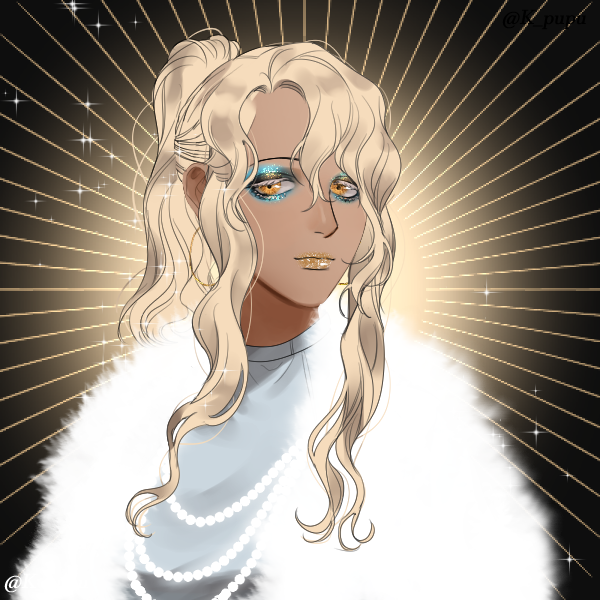
I used this specific Picrew as Amezi’s pog for that online game.
This game was insane. The DM was a conservative trans woman. One of the players was a Nordic neo-Nazi. And then one of the other players—was in love with me!
Well, in love with Amezi. Amezi got to be a little more flirtatious in this game, though they still butted heads with the PCs on occasion (especially the neo-Nazi’s, imagine that). They did, however, develop a dynamic with a Goliath PC; the Goliath was soft-spoken but full of inner rage, while Amezi was a brat who was great at absorbing that rage. I wrote a NSFW fanfic of the two of them, which you can read here (someday, when AO3 isn’t down… man, I gotta catalogue my fic on this site).
However, I made a crucial mistake: while I was just roleplaying, the other player was not. I talked to them a few times out of the game, and they flirted with me, sent me selfies, and even sent me gifts. I did not reciprocate the feelings of this person… but I didn’t want to leave the D&D game, so I let them down gently. It wasn’t me, after all, who they were in love with—they were in love with the loud-mouthed, sexy, spitfire Amezi. They confessed their love without knowing anything about me. Amezi was just that charming.
That game eventually piddled out, too. I don’t think it ended bombastically—I think we just drifted apart. I played Amezi in a few games after that—oneshots and games that never quite got off the ground. At some point during the pandemic, I graduated from player to forever DM, and I didn’t get the opportunity to play as Amezi for a while.
During this time, I wrote Amezi as a character for a NaNoWriMo novel I never wound up finishing. The story took place in what was essentially my Solrazé D&D setting, except without the D&D. In that version of the setting, the cataclysm that destroyed the world—a collision of Earth and a nameless fantasy realm—wound up scrambling the souls of all lifeforms, thus producing animal/human hybrids. One of the characters was a little wolf-rabbit thing who looked like my sona Cholla, for example. There was also, like, a Steven Universe-esque fusion component where you could merge souls with another person to create an even bigger abomination… anyway, Amezi was a rogue-like character who was obsessed with pre-Cataclysm culture and technology. They carried a Walkman around and listened to Elton John, as well as tailored their clothes in the style of 80s fashion magazines. Eventually the plan was for him to fall in love with the protagonist, a Gleaming Guard for the Starslayers, who would turn against the establishment to bring magic back to the people. I had an outline for this story and wrote about 50k words, but it was way too ambitious. I’ll probably never finish it.

I commissioned an artist on Reddit, again lost (I need to keep better track of these things), to color a snake base by Cindy Avelino to match Amezi’s coloring. Amezi’s pattern is based on an albino Western diamondback rattlesnake; my college had one on display that I walked by on the way to class that I was very inspired by. I imagine, in thi universe, Amezi could shift into a more anthro-like form.
In tabletops, I made Amezi appear as a cameo in one of the games I was running. They were supposed to be this obviously bogus treasure hunter leading a group of adventurers on a suicide mission into the desert to search for a lost city of gold. However, the players were so enamored by Amezi’s charm that they decided to join the suicide mission! It made me feel so proud of my little guy.
When I roleplay Amezi in-person, I do an accent. I tried, originally, to do German to match Klavier, but I was simply unable to perfect it (I’ve gotten better at German—Respite, for example, speaks in a German accent to represent his childhood in Melvaunt… and also because he’s based in large part on Kurt Wagner). Instead, Amezi’s accent is made up. I roll my Rs, I elongate my Ss. I guess it sounds kind of like a Zevran accent from Dragon Age? What’s that supposed to be, Spanish? I dunno—it’s a made-up mixture of different accents. I know there’s discourse about if you should do accents in D&D games, but I personally find them fun—so long as you’re not actively engaging in racist stereotype, you know?
I also feel like I’m more exuberant when I’m doing this voice. Something about doing an accent inspires me to “act” more like the character—I gesticulate, I smile, I lean. I play my character Lux Ivory right now, and he does not have an accent—I try to speak deeper, but that’s about it. Now, Lux isn’t a very “exuberant” character to begin with, but I still feel like they would be more fun to play if I gave them a real voice. I’d headcanon it as British… but I can’t do a British accent at all. It’s so hard!
Anyway, I think this is what draws people to Amezi: they start out charismatic, larger-than-life… and their anger is, inevitably, what pushes people away. I have been criticized many, many times for being too angry as Amezi. I am an angry person in general. I’m an Aries, after all. Wink.
I’m still an angry person. I would like to say that I’ve mellowed out, but maybe don’t ask me that right now. But, on average, I’m calmer. I am not as spiteful a person, and therefore, I don’t feel the need to make Amezi as spriteful, either.
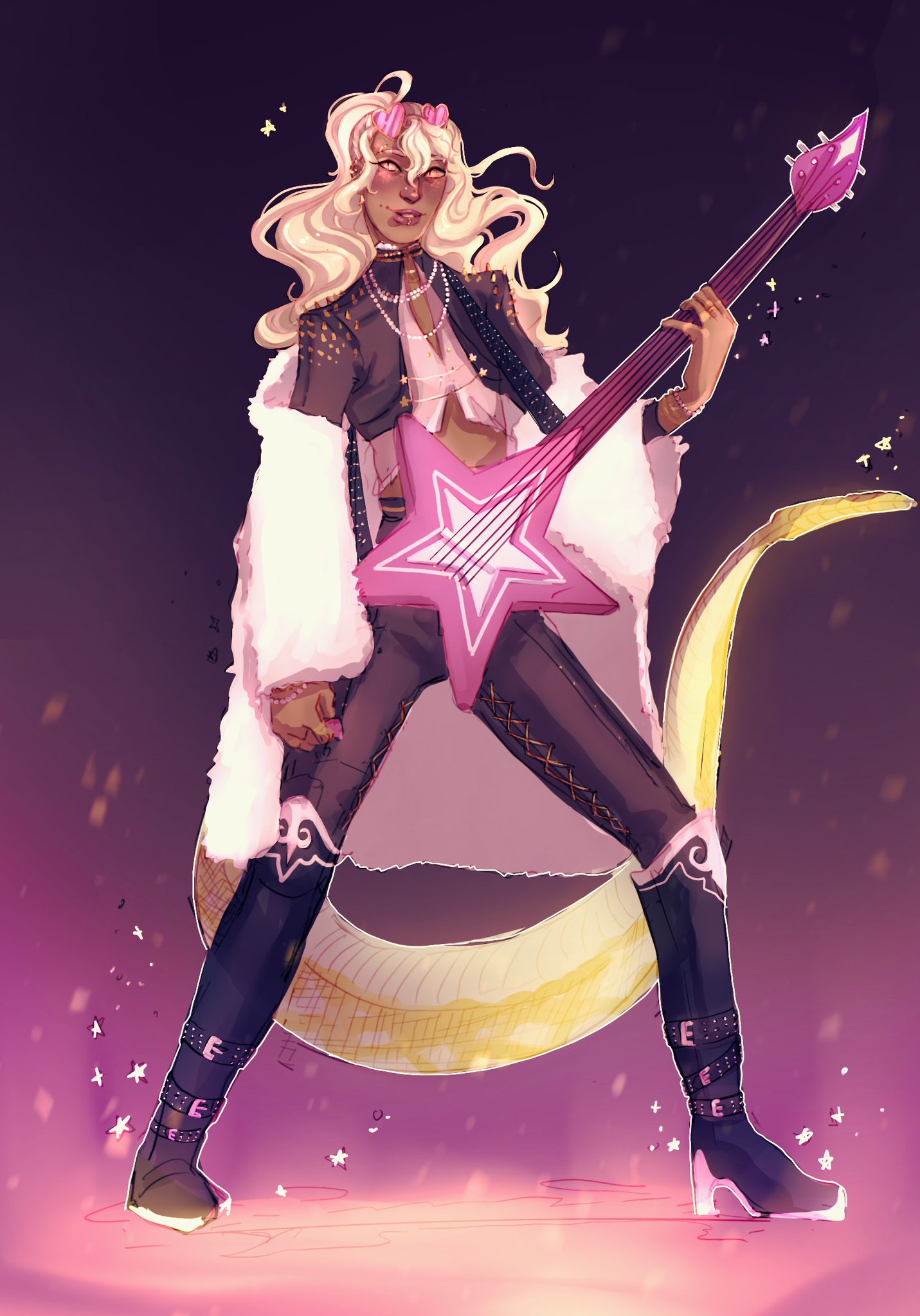
This was the first piece I ever commissioned of Amezi. I think it was actually my first piece of commissioned art ever. I thought the artist was lost, but according to my Toyhouse, it was made by pear_adox!
Many years later, I got to play Amezi again in a short-lived campaign with my friends. I decided to change the backstory to eliminate the sexual assault, turning a twelve page backstory into two; instead, Amezi simply has a powerful ex with a problematic power dynamic who’s the leader of a crime ring. I wrote the backstory to fit the homebrew campaign, and then I retooled it to be set in the Forgotten Realms as their “canon”—with Amezi being an ex-member of the Zhentarim. This version of Amezi I gave a different name: Amezi Heliodoré… but it didn’t stick, and I eventually went back to Goldenscale.
However, this sanitized version of Amezi has always felt wrong, to me. They still wound up maintaining some of that anger I originally wrote them with… but this time, it felt aimless. Without tragedy, their bitterness at the world seemed shallow. I didn’t really get to explore this aspect of Amezi in-game—in fact, I wanted to keep them a simple, shallow character to allot for a more streamlined roleplay experience—but I couldn’t shake the feeling that this version of the backstory had something missing.
A brief digression.
I have encountered a couple characters across media who have a very similar backstory to Amezi—two, in fact. One is praised as an excellent portrayal of the difficult topic of sexual abuse and trauma, and one is considered an awful, disrespectful mockery of it. These characters are Astarion from Baldur’s Gate 3 and Angel Dust from Hazbin Hotel.
Both of these characters spend their undeath in servitude/slavery to a powerful lord who controls every aspect of their agency, including using their body as a sexual tool to maintain their own power. Both of them have a difficult relationship with sexuality; on the face, they’re hypersexual, both in part because it’s how they can retain agency of their abuse, but also because it’s a fawning mechanism and all they know how to do in order to survive. This is also how I imagine my previous version of Amezi.
Angel Dust’s turmoil is often played for laughs—Hazbin Hotel isn’t a great, nuanced depiction of abuse. Astarion’s story, on the other hand, is one of the most devastatingly poignant explorations of the cycle of abuse I have ever witnessed in any medium ever.
When I played BG3, I was playing as Amezi. In name only, really—I was far more heroic than Amezi would’ve been, and I wanted to see the consequences to choices Amezi would never have made. I romanced Astarion, but I quickly realized that Amezi and Astarion are incompatible. Their trauma is similar, but different in minute ways that I had trouble putting to words.
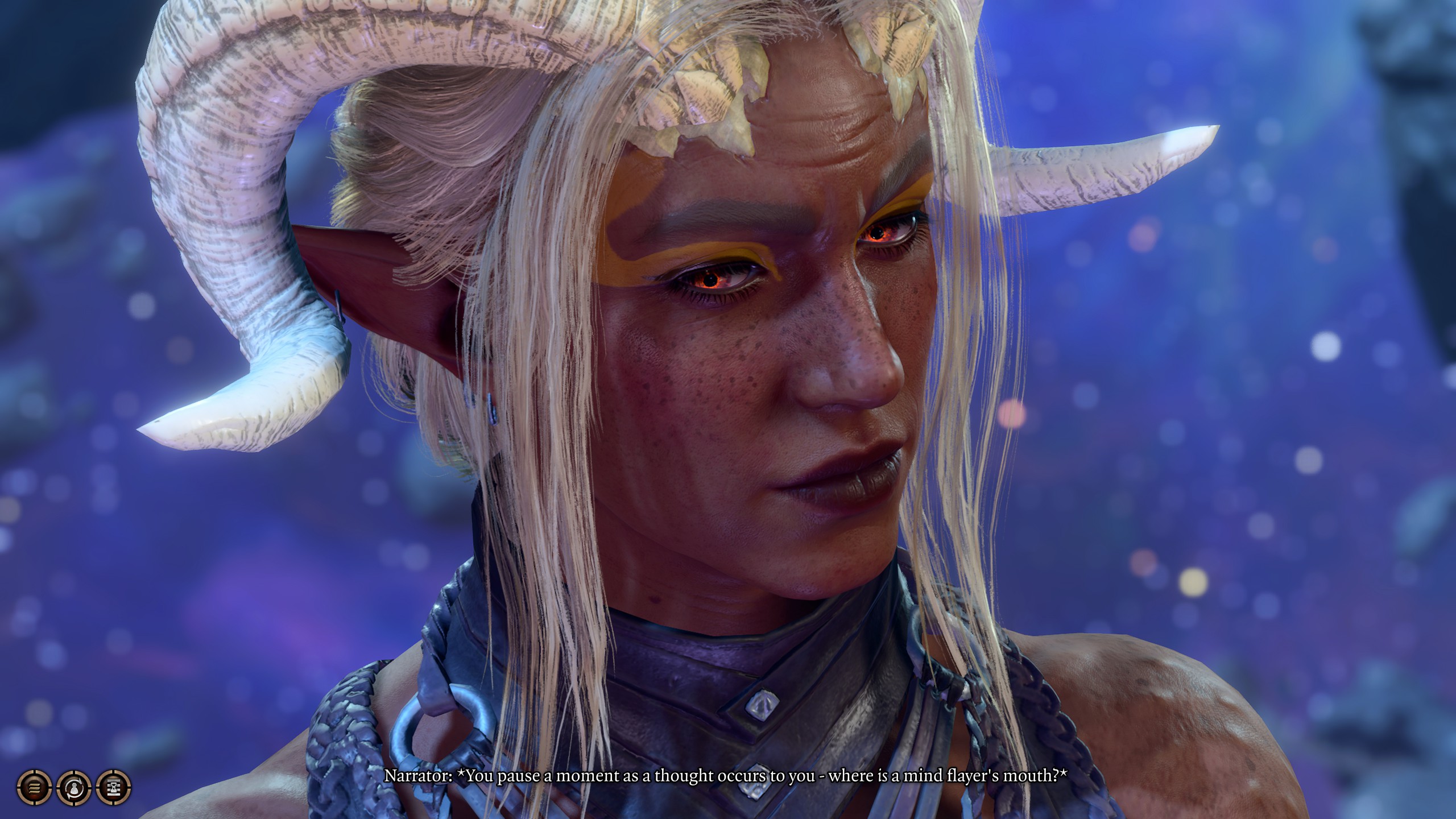
There was no yuan-ti option in BG3, so I made Amezi a tiefling instead. And of course, they fucked the mindflayer. And Mizora. And Harleep.
Astarion is not a sexual character. He acts sexual at the beginning of the adventure, and he cracks the occasional lewd joke—but it’s a facade. His body has been extorted by his vampire master for 200 years, and luring people to their doom with his body is all he knows how to do. When you romance him, he unravels, and the bulk of his story is about him trying to understand what to do with this newfound agency—for example, he struggles with the question of whether he wants to continue his cycle of abuse by murdering 7000 souls, or escape it by acting the hero, even though no heroes ever came to save him during his years of torment.
Similarly, Amezi also resents gods, nobles—but not heroes. Heroes never came to save him… but with his freedom, he vows not to let anyone suffer as he did. He cares so, so much about the agency of others, and he will always fight to free people of servitude. No heroes saved him—so he will become the hero who will not only save others, but save himself. This strive for heroism is necessary for a character in a D&D game—I don’t think Astarion would last long if you brought him to a table with real players.
Amezi is also sexual… but it’s complicated—just a different kind of complicated than Astarion. Amezi views sex as an extension of their agency. Where once they were forced to engage in sexuality, they now do so on their own accord, freely. It’s not a healthy coping mechanism—they are, indeed, hypersexual. They use sex as a weapon against others, as a way to ingratiate himself or derive info from them. It’s a compulsion—they need to have sex to feel wanted, beautiful, useful to themselves. They feel powerful during sex. It’s a primal, animalistic drive for them.
Again, not healthy—but this is where Amezi is during the start of any adventure, and he has to go on his own journey to fix his relationship with sex. This is incompatible with Astarion. Two moments from my playthrough really stood out as direct proof of this: at one point, Astarion confides in Tav and says that he doesn’t want to have sex, as he doesn’t want to be seen as the sexual creature he was forced to be for so many years. In order to continue the romance, you must respect his wishes and love him without sexuality.
However, there is a line Tav can say that Amezi would, 100%, due to his own trauma: “You can learn to enjoy sex, and you can learn to enjoy sex with me.” If you say this line… I think you wind up sleeping together? But soon after, Astarion breaks up with you with a surge of renewed confidence, understanding that he is now allowed to say no. This is a wonderful character moment for Astarion… but I can’t help but think about how Amezi would argue about this, and how he would eventually wind up confronting his own sexual trauma. I don’t think it would get that far, though—the two would break up angrily and messily before they could work out either of their issues, I think.
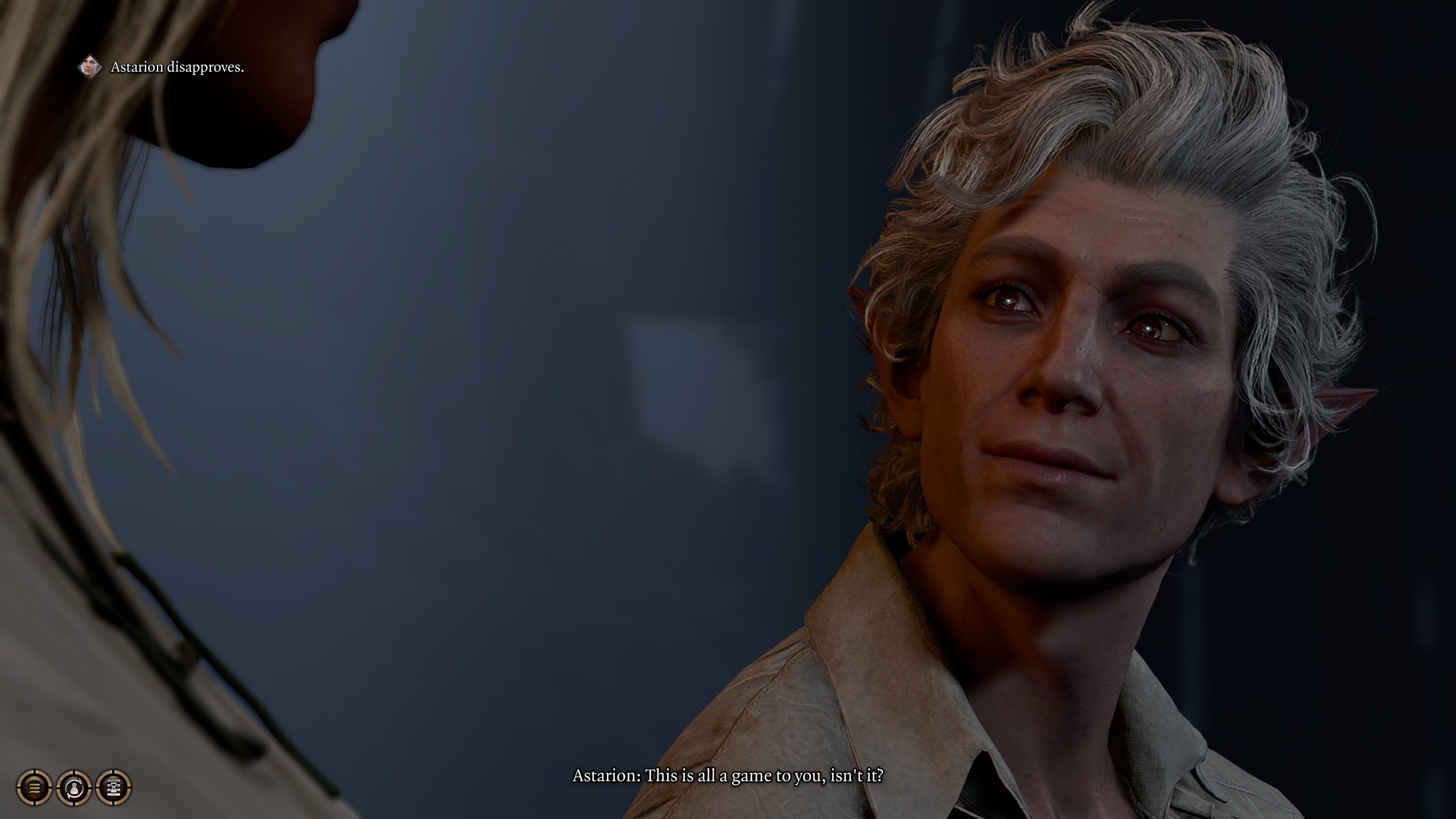
Look, I actually found it in my screenshot folder! This response from Astarion would have made Amezi painfully upset.
(If I had to pick a BG3 origin character that I think Amezi would actually be good with, I’d say Karlach. Her good-spirited will to help people would stamp out Amezi’s cattiness… plus, her sexlessness at the beginning of the adventure would force Amezi to discover what it is to love without sex, which I think would be good for their arc. Similarly, if we’re talking about canonical BG3 ships, I think Karlach is also best paired with Astarion for nearly identical reasons. They’re just so similar! I swear, I made Amezi before BG3! Parallel thinking, I suppose—and no idea is original.)
The second instance is if you choose to sleep with Raphael’s incubus, Harleep. If you bone them, they steal your character’s form and use it to have sex all across the Nine Hells for all eternity. If you’re dating Astarion, which I was, he’ll pull you aside and say, “I know what it’s like to have your body used without your consent. It’s a disgusting feeling, and you can confide in me,,” or something to that effect.
I think this is actually Amezi’s dream. To have their visage immortalized at its most beautiful, to be adored by people across all of the realms, to be kissed and loved for all of eternity and to feel a shiver of pleasure whenever it happens… that’s ideal, at least before their reexamination of sexuality. They consented to it, and they’re fine with it.
…I think my original point in bringing up these two franchises is that I worry that Amezi is closer to an Angel Dust than an Astarion. It’s hard to write sexual trauma well. I do not claim to be an excellent writer, but I would like to hope that the thought and care I’ve put into this character lends them the necessary nuance to be considered respectful.
Anyway. Enough of that. Flash forward to now—I am still obsessed with Amezi, and I would like them to have this complicated, serious backstory ala Astarion. I understand that I will likely never play Amezi in a physical TTRPG again, so… if I don’t have to worry about making a game-friendly backstory, then I can do whatever I want, can’t I? I can give this guy All Of The Trauma!
Thus, I rewrote Amezi’s backstory for the umpteenth time, and with it comes a new name: Amezi Summerscale. In addition to giving them this more sexually-charged background, I also wanted to address a crucial part of Amezi that none of their previous backstories really managed to explore: their yuan-ti heritage.
This version of Amezi has always been both beautiful and frightening. They are gorgeous, but their snake-like features—a forked tongue, a gaping jaw, hard scales—are uncannily inhuman. Because of this, Amezi has always been viewed as a beautiful oddity: something to ogle, but not love.
I have lots of mixed characters. I am mixed race myself, and I relate a lot to stories about struggles with defining oneself as one particular identity. Amezi was raised in a realm of humans—they know nothing of their yuan-ti heritage, and yet they act as if they do, because that is what people expect of her. Is it good that Amezi plays up problematic stereotypes they cannot possibly understand or relate to? No, and it’s something they have to grow out of over the course of an adventure.
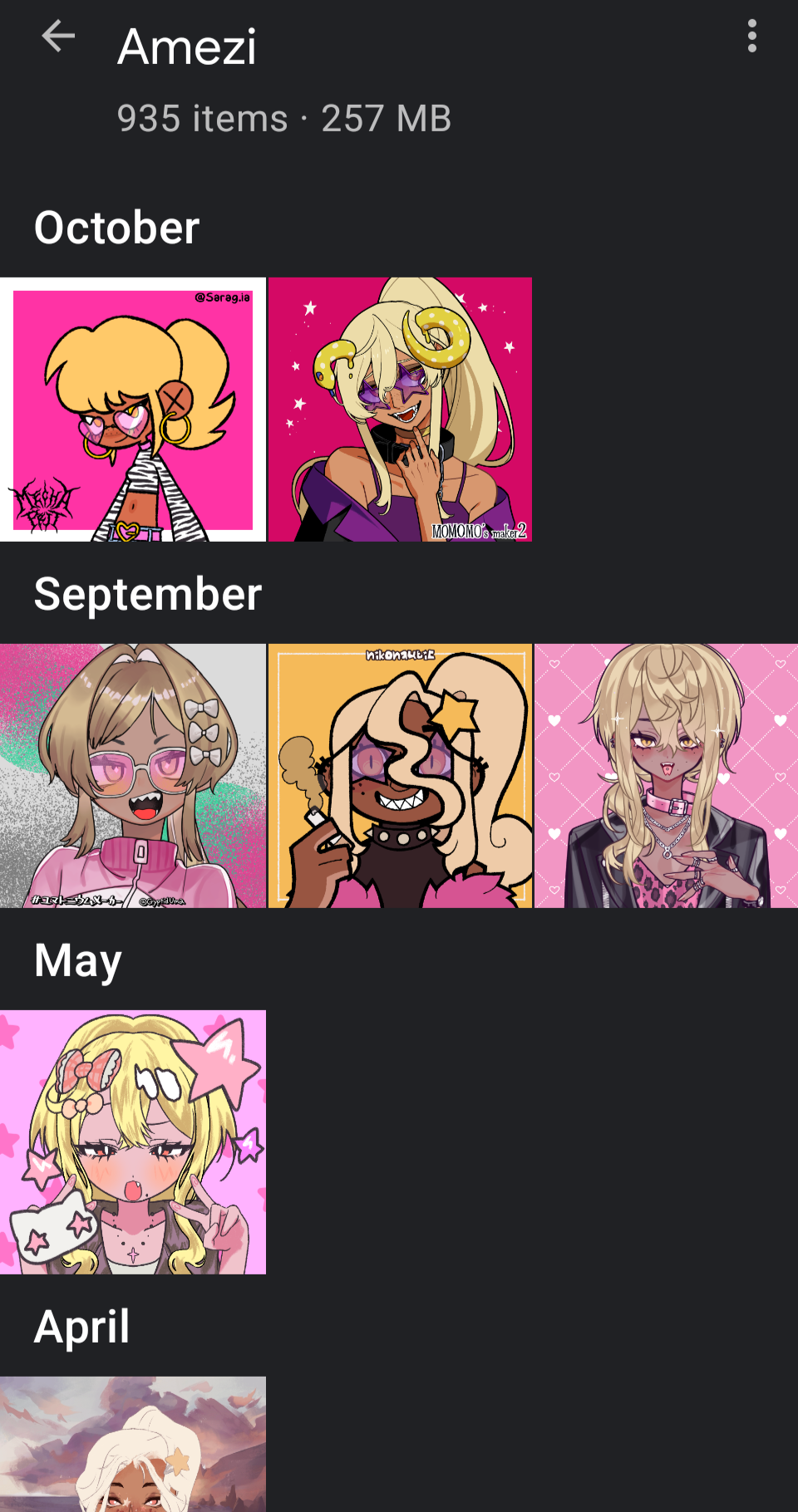
I have nearly 1,000 Amezi picrews. And that’s after I lost all of my photos circa 2020. I just like to make them, though it’s difficult given their skin tone.
However, it’s not just about race—it’s about humanity. Amezi wants to fit in with humans, and yet they are not one. They don’t feel in the same way a human does. Their brain is distinctly reptilian: sometimes they don’t feel at all, other times they feel too much. Sometimes they are overcome with soul-splitting rage, and they want to consume the world whole. Other times, they feel nothing at all—even when a friend dies in their arms. They want to cry, but they can’t. Other times… the tears won’t stop. All of their emotions are wrong, uncanny, because they are not quite human—even if they so desperately want to be. Why are they like this? Can they change? Are their emotions still “human” after all—or are they indeed alien, but they’re worthy of respect anyway? All of this and more to be explored in a further adventure.
This is what I think Amezi was missing, and it’s a deeply personal struggle for me: one of neurodivergency. Not all of my characters are reflections of myself, of course. Well, they’re all a part of me in some fashion, and people do tend to write what they know, but Amezi in particular is one of my most personal characters (being my current oldest and all). I want them to carry my struggles, in a way. I want them to be mine, to separate them from the Astarions out there.
I have… lots of neurodivergencies, shall we say—some diagnosed, some not. My emotions are always overwhelming, and I am often left thinking: “I wish I was a normal human. Sometimes, I don’t even feel human.” That is the struggle I want Amezi’s character to explore. I want them to fight with themselves about what it means to be human.
Of course, I added the sexual stuff back in, too. I dunno—Amezi is a sexual character, and they feel like they’re lacking something without it. In this version of Amezi’s backstory, they were recruited by a group of travelling glamour bards due to their exquisite beauty. The leader of this group is an elf named Shallaya, as a reference to their original mentor. However, it is eventually revealed that Shallaya is a shrewd businesswoman, and she treats the members of the troop like idols to be extorted and used; they earn nothing for themselves, even during private shows—and sometimes sexual services. I tried to bring in aspects of that Genji courtesan culture that inspired me so much originally: while these bards are poets and artists, they are still at the whim of their customers, even despite their renown. Also, Shallaya drains the life energy of the bards in her entourage to stay young, and she’s been doing this for a thousand years so she has an untouchable reputation… yadda-yadda, have to make it magical somehow. Either way, the sexual component—especially Amezi’s inner turmoil of yearning for that sexual agency, but thinking themselves undesirable because of their inhumanity—has returned to the character.
“Is this also based on your own experience?” I’m not getting into that. What are you, a cop?
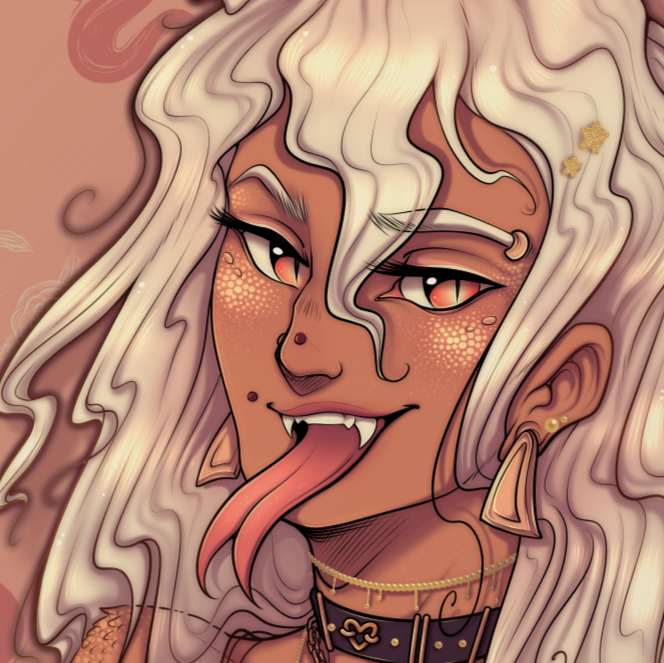
This is a crop of one of my favorite Amezi pieces, drawn by sharkyshon, where the artist went out of his way to doodle, like, six different snake penises for me to choose from in order to give Amezi the weird, alien hemipenes they deserve. I wasn’t expecting so much effort to be spent on snake dick, but it left a lasting impression on me. What customer service!
I also characterized Amezi’s fellow victims this time. During their first backstory, they were rather faceless—this time I gave them names and relationships with Amezi, each one representing a different difficulty Amezi has to process. One was originally kind and brotherly, before turning against Amezi out of jealousy. One Amezi was close with, like a lover—but eventually “retired”/disappeared, and Amezi found that he couldn’t cry for her. Another, Amezi was bitterly jealous of, and they sought to sabotage her—and now he feels immense guilt. Etcetera, etcetera; I only have a few fleshed out right now, but in a perfect world, I would like for each member of the troop to represent one of these values/goals Amezi embodies.
Amezi does have a page on here, though as of writing, it contains the sanitized backstory. I think I would like to update it with the new one sometime soon. I’m a little nervous putting such a sexually-charged piece of fiction as the very first character linked, but… uh, their explicit oneshots have been linked since the beginning, anyway, so I doubt it’ll be that big of a deal. I’m not going to censor myself anymore—at least as long as I’m not playing games with strangers. This is Amezi—and this is me! And I am proud of the character I have created.
Here is the rough, rough draft of this new backstory, for your eyes only! I promise that it will be a lot more polished when I publish it to Amezi’s page. Click to expand.
Amezi wasn’t born “Amezi”. They were born an orphan-child—an unfortunate commonality in the mostly half-elven community of Loudwater. Even among the downtrodden, Amezi found themselves an outlier: there was nobody else like they of golden-scale and rattle-tail. Their hatching seemed, to the people of Loudwater, like a bad omen. Wretched creatures, snakes—and what a cursed existence it must’ve been to be stuck somewhere between human something so disgusting.
Disgusting, people would think on the face—but in reality, Amezi was born beautiful. The golden scales freckling their cheeks, shoulders, and tail caught the sun in the most brilliant way. Their warm, dark skin absorbed all light and all attention. They drew eyes like no other. A hair-trigger response of fear elicited in the hearts of both peasants and princes would be quickly usurped by a hypnotizing desire to protect, to possess, to love. Amezi possessed a natural, near magical charm that promised protection as much as it courted danger.
Amezi doesn’t know who raised them—street-mothers, most likely, fighting to keep the beautiful baby theirs. As Amezi aged, they quickly realized the extent of what they could get away with. They learned the tricks of the street—they’d lure in travelers with their charm, then pickpocket them for their gold. They swiped fresh meats as often as they’d convince someone to buy some for them. Their childhood was a lonely one; their fellow street urchins resented Amezi’s ability to lure in kind hearts. Amezi, meanwhile, resented these good samaritans. They hated being ogled; they knew people saw them as a curiosity, and their love for him was what one would feel towards a painting or a statue. Amezi was a pretty thing—not a person, not a human. A snake, better suited for leather than love.
Thus, Amezi didn’t allow anyone to get close. They lived this treacherous, urchin life until they were 14-years-old, when a traveling troop of bards happened to pass through Loudwater. Their outfits were bright and beautiful, and their songs seemed to sparkle in the morning mist. The entire town was drawn to them, including Amezi. He tracked the troop down to the tavern they were staying at and watched their performance from the shadows. He was especially entranced by how every member of the troop flourished in the spotlight. They made themselves out to be oddities—dressed in exuberant fashion, painted their faces in delightful makeup—and they relished in the attention. To Amezi, it felt alien to want such attention—it had always been thrust upon him without consent.
Amezi snuck into the troop’s room with the intention of stealing some of their clothes and makeup. However, before they could escape, the troop’s leader, Shallaya Yearsbound, caught him in the act. Rather than reprimand him, Shallaya’s eyes twinkled: she recognized in Amezi a potential show-stopping act. She sat him down and told him that, as punishment for stealing, he would have to work off his debt… by performing with the troop, which she introduced as The Six Seasons.
Shallaya herself was an eladrin of incredible beauty. She had formed the Six Seasons hundreds of years ago: the troop was composed of non-fey mortals to whom she would share the secrets of her fey magic with. The Six Seasons were renowned the realm over for their wondrous performances, their captivating magic, and their incredible allure. Shallaya would choose a performer around thirteen to eighteen-years-old—or whatever constituted as teenager for their specieis—whereupon they would perform with the group until they were around thirty. All of the troop members were direct apprentices to Shallaya, most of whom had been trained since birth to catch Shallaya’s eye—so coveted was the position of Season.
Amezi’s introduction to the troop was not unprecedented—Shallaya had plucked random youths out from the darkness before—but it was still news and noteworthy. Amezi found themselves thrust into an extremely busy lifestyle, with constant training and traveling. They learned the basics of nearly every instrument—with a special emphasis on the guitar (or lute)—as well as how to sing, compose, and dance. They were fitted for gorgeous outfits and taught how to apply exquisite makeup. They also, of course, learned about spellcasting: magic was woven into every one of Shallaya’s songs. This glamour would both enhance the performance with sparkles and color, but also affect the minds of those who listened to it, charming them into a near-fanatical worship of the troop.
While Amezi’s fellow performers resented them at first, they soon formed a competitive camaraderie. They were all equally beautiful and talented, and they craved attention and worship alike.
The first couple of years performing as a Season were like a dream. Amezi learned to love stardom. It was different when they were on the stage: it was as if they became a character, like a lead in a play. It was armor, for Amezi—no longer were those leering, lecherous stares aimed at the snake beneath, but the musician dolled up in drag. It was during this time that Amezi began referring to themselves as Amezi—a stage name given to them by Shallaya herself.
They lost themselves in performance. They mimicked the behavior of Shallaya: they became flirtatious, charismatic, luring and lulling. They began to crave opulence, like soft silks and precious gemstones with which to accentuate the beauty they now wielded as a weapon. They played up their role of yuan-ti, especially. At Shallaya’s insistence (to make Amezi “stand out”, she said), they incorporated stereotypical yuan-ti “culture” into Amezi’s personality and performances. He rejected this at first, ashamed and afraid of his snake heritage, to which Shallaya replied: “Your monstrosity is what makes you beautiful. Don’t hide it—embrace it. If you cannot embrace it as you are, become someone who can.”
Thus, Amezi developed a fake accent that most humans associated with the yuan-ti. He was often dressed the most risque out of all of the performers, and they played up a lavicious, sharp-tongued, and scheming nature.
Amezi was, perhaps, all of those things at some point or another. However, as direction was given by Shallaya—slowly at first, then constant criticizing—Amezi began to lose track of what was their own personality and what was this gaudy, glamorous facade Shallaya groomed them into. This mean-spirited, catty character was easy for them to embody; it was so much simpler to be someone else, someone confident in their fraudulent persona, than to confront whatever abyssal abomination actually lay beneath the surface.
What started as admiration for Shallaya, too, became more complicated as time went on. Shallaya was, of course, the leader of the troop—all of the eyes were on her first and foremost, which Amezi felt jealous of. In addition, Shallaya was very strict behind closed doors: she wrote roles for all of the performers that they had to follow perfectly, or else they’d be criticized… or punished. Sometimes food would be withheld or sleep interrupted. However, Shallaya preferred a specific kind of punishment: if someone did not meet her expectations, Shallaya made them clutch a crimson-colored red stone with jagged edges until their palms bled. Their blood would be absorbed into the stone, after which they would feel fatigued and nauseous—and Shallaya would be satisfied that a lesson had been learned.
In addition, none of the performers received any pay. They were dressed in fine costumes and jewels, but none were theirs to keep. They were all Shallaya’s. If they received a gift from a supporter, it had to be reported to Shallaya, lest they be punished with the bloodstone. Even when Shallaya introduced high-paying nobles and ordered a performer to “entertain them privately”—there was no compensation. Shallaya used them: she’d lend them out for entertainment and sex and keep all of the exchanged gold for herself. When asked, she’d claim it was for the Six Seasons at large, and as the leader, she knew what was best for the members. She had been running the troop for hundreds of years, and they always had a warm bed… didn’t she always know what was best?
This was simply what success was like, Amezi told himself. The world was one of predator and prey; Shallaya had created a business appealing to the wandering, hungry eye of the starving beast by dressing their prey up in decadence. What other choice was there than to play along? The only other option was to become the predator himself—he could split those leering smirks in twain and consume their fat, rattish bodies whole. Some part of him wanted to. Every wandering hand, every spared smile made Amezi want to bite, kill, swallow. It scared him terribly—each intrusive thought was a reminder that his humanity was all a facade, and at his core, he was an animal with no emotion save hunger. It was better, he figured, to play his part in his little zoo.
Performers never left the troop, even with all of the punishment. Shallaya, instead, would dictate when their time was over. It was always sudden, and there was never a good-bye: Amezi would wake up in the evening and the friend they had known for years would be gone. After which, Shallaya would whisper rumors that those members spoke ill of Amezi—or any other troop member. Despite performing as a well-manicured family, Shallaya made sure none of the troop members formed any real relationships with each other: she egged on their egos by pitting them against each other and sewing deceit.
Amezi spent the next fifteen years of his life like this, until he was 29. A decade-and-a-half had left Amezi dreamless, drifting, and dissociating. As long as they didn’t think too hard about their circumstances, they were fine. As long as they didn’t think about freedom or agency—as long as they convinced themselves the people they slept with were victims rather than customers, as long as they didn’t think of the friends they had lost over the years—then they could survive. Amezi could’ve very well lived the rest of their life like this, preening and pompous.
And then, he got a gray hair. Many, many gray hairs—and wrinkles, and cellulite, and other tell-tale sides of slowly encroaching age.
On his fifteenth anniversary as a member of the Six Seasons, Shallaya pulled Amezi away from the group and led him deep into a nearby forest. There, she turned and handed him the bloodstone. Amezi asked what he was being punished for; Shallaya explained that this wasn’t a punishment at all. Rather, Amezi had been a dutiful Season—performers rarely ever aged out. But that was exactly it—he had aged out. His beauty and youth were fading, and Shallaya had no use for him anymore. “You’re of no use to anyone without your beauty,” she told him. “But there is one last thing you can do for me.”
Shallaya explained that the bloodstone was a Ruby of Rejuvenation; if the stone was used to draw blood, it would absorb the life essence from the victim and transfer it to the attuned in the form of time. Every droplet of blood corresponded to a year. Despite Amezi only being around 29, with how much he had been punished, his age instead roughly corresponded to 35. “An impressive age,” Shallaya remarked. “I’ve never allowed anyone in the Seasons beyond the age of 31. Your beauty lasted you a while.” Shallaya was indeed an eladrin, but her desperate need to maintain her beauty had driven her to madness: every performer who had “left the troop” had actually had their essence consumed by the stone and passed onto Shallaya so that her beauty would never fade—and she had been doing this for over six-hundred years.
Shallaya intended to magically compel Amezi to do the same—squeeze and squeeze the stone until all his blood ran dry and he had no years left. However, in her apathy, she forgot something crucial: Amezi’s innate magical resistance. She attempted to compel him to her will, but he powered through the charm—and, as she reeled in confusion, fled into the night.
Amezi ran, putting as much distance between himself and the traveling Six Seasons as possible. It was difficult, though, without so much as a copper to his name—and while he could still rely on his looks and notoriety to help, it is indeed getting harder with age. As he fled from city to city, he caught rumors of the Six Seasons following in his tracks, attempting to catch up to him—slowly but surely, like the shadow of time.
It has been a year since Amezi fled from the troop. During that time, Amezi has taken on the mantle of adventurer, since it pays better than courtship or performances. They’re a vagabond—a beautiful wanderer who helps the needy and breaks a few hearts before moving on to the next town. They see the suffering of others far more clearly now without Shallaya’s words soothing their worries, and they seek to liberate others from the shackles binding their freedom. They also strive to provide for the needy so they do not fall into the same predatory traps he did.
Still, it’s hard for Amezi to define himself. He doesn’t know what thoughts are his own and what thoughts are Shallaya’s. He does his best to distance himself from her—he dyes his hair and wears wild, garish clothes Shallaya would’ve never bought for him—but still, he is recognized as Amezi Summerscale of the Six Seasons. He has not attempted to tell anyone of Shallaya’s crimes, as he knows it is his word against a legacy. It is his ultimate goal to one day avenge all of the young beauties Shallaya lured into her grasp to bleed for her—he dreams of subjecting her to unspeakable atrocities… and then wonders if that would make him just as much of a monster as she. Thus, he shunters those thoughts aside. Until he becomes stronger—and most of all, braver—he’s content with running into the horizon and not looking back.
Six Seasons Info
The Six Seasons always had exactly six members representing six seasons. They each had stage names bestowed to them by Shallaya—their first name was usually meaningless, but their last name always incorporated the season they represented.
The seasons were spring, summer, rainy, fall, and winter. Shallaya herself represented the year itself—the hidden, all encompassing “season”.
Amezi has had several meaningful relationships in the Six Seasons.
Sylvain Raincloud, a half-elf man. Was the first person to warmly welcome Amezi to the troop and acted as a nurturing big brother. However, after a year, Sylvain began to act cold and distant to Amezi, and eventually accused them of sabotaging Slyvain’s own act as the “oddity” of the group. (This was Shallaya turning them against each other.) “Left” the group a little afterwards.
Morella Springstep, a satyr woman. Rambunctious and always in good spirits; would regularly party with Amezi and nobles. Friendly rivals. Morella confided in Amezi one day that she was afraid Shallaya was being too harsh to some of the new members of the troop… and she “retired” but a few days afterwards. This particular loss left Amezi feeling incredibly distraught—but he disassociated enough to set the feelings aside.
Cassanta Springbeat, a human woman successor to Morella. She was drop-dead gorgeous, and Amezi grew jealous of the amount of attention she received. He would regularly try to sabotage her, including spiking her drinks with mild poisons or destroying her clothes. Cassanta was still a member of the Six Seasons when Amezi “graduated”. He feels guilty about how he treated her, and he hopes no harm has come to her.
End of Backstory
Amezi has grown alongside me. With each iteration, they wind up reflecting whatever inner turmoil I’m dealing with at that time. Ten years ago, it was raging at unfair systems—and today, it’s struggling with what it means to be human. Ten years ago, he was a man—now they’re genderfluid, like me. Amezi is not me—none of my characters are—but he is indeed a glimpse into my psyche. He’s important to me, and I love them dearly. I hope, one day, I am able to give Amezi the adventure and growth they deserve—whether that’s in roleplay, tabletop, a written narrative… or perhaps simply embarking on an adventure of my own, and reaching a peace wherein I no longer feel the need to reflect upon my inner conflict through the realm of creative fiction. I think that’s unlikely, though. I’m not sure such a peace exists for anyone, of any time—there is, after all, a reason why we still write.
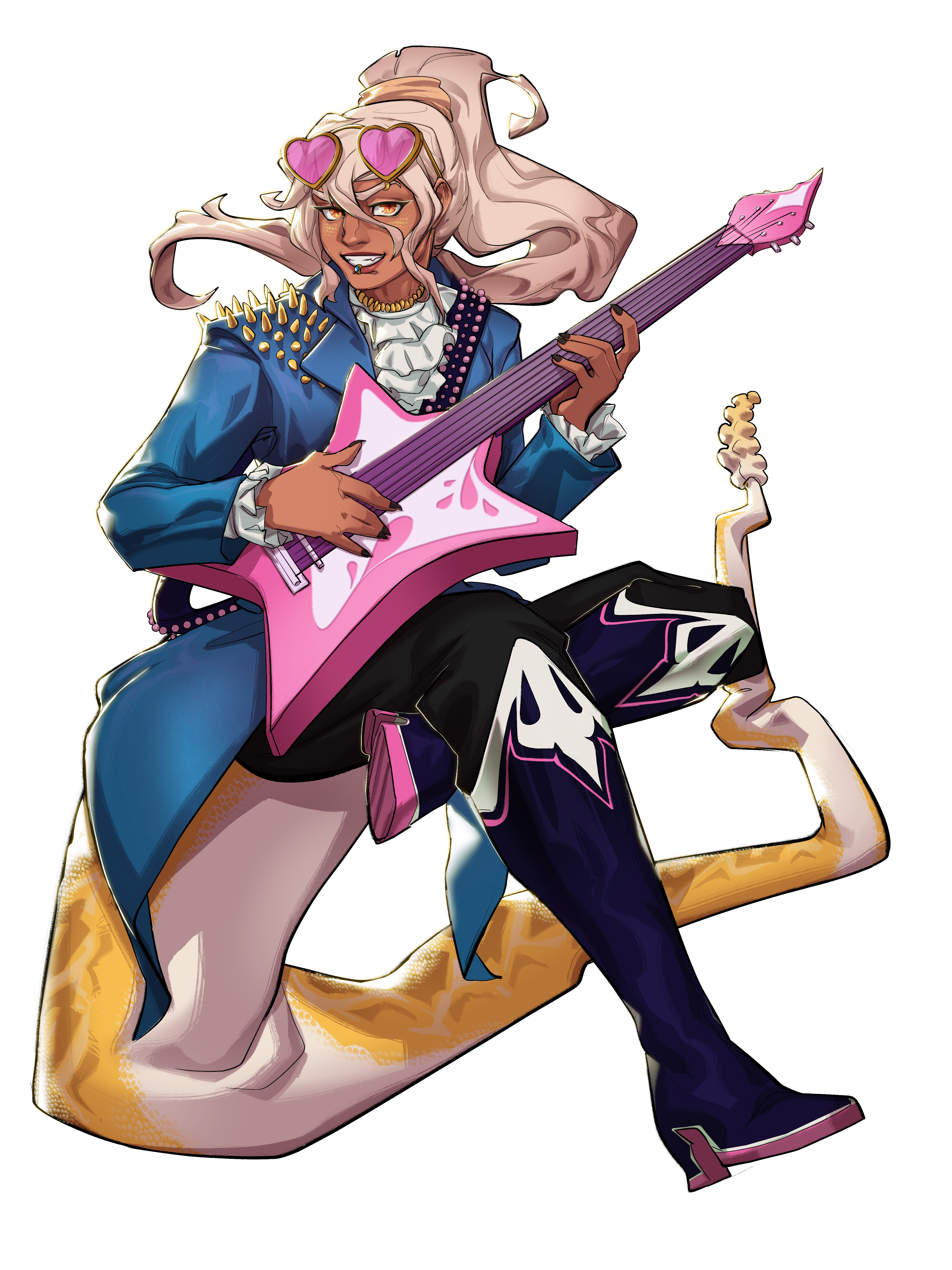
This piece, drawn by paimo, was finished today! My anniversary gift!
Happy anniversary, Amezi! I love you, and I’m sorry you’ve gone through so much. I promise that, in some universe, I will give you the happy ending you deserve.