
Sweet Pool Is the Scariest Piece of Horror I’ve Ever Consumed and It Will Never Get the Recognition It Deserves Because It’s a Gay Porn Game
08.13.26 // 1:13am
Hoo boy, have I been busy! It feels like all of my days are completely booked up with the whole streaming thing. I don’t know how people manage to consume media on top of working, hanging out with friends, having a life… it’s wild! I have to draft up a video essay here soon, too—the topic is going to be “What is Moe”. I figure I’ll treat it like one of my blog posts… but with more research in the final draft. These blog posts tend to be more stream-of-consciousness style, but I think people are expecting more of an analytical essay….
Anyway, before I get started on that, I need to write my August blog post. I know if I flub one month, this manic streak that I’m on will end, and I’ll never feel compelled to write another blog again.
Today, I want to talk about a visual novel I recently finished by the name of Sweet Pool.
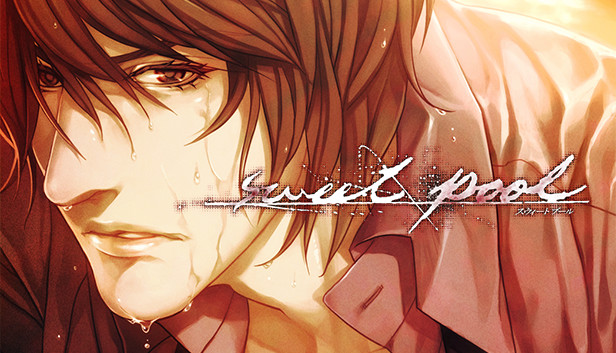
With art by Onitsuka Seiji, story by Kabura Fuuchi.
I’ve been working my way through some classic anime VNs as I embrace my love of moe, doujin, and all things anime. I played Totono on stream, am playing Kanon now, and have played a couple silly/fluffy games off stream. A week or so ago, though, I decided it was time to mix it up with some yaoi.
Nitro+Chiral is the most well-known developer of BL games the world over. Their biggest claim to fame is Dramatical Murder, which features Aoba Seragaki, the blue-haired yaoi Jesus of internet fame. I played Dramatical Murder years ago with a fanpatch—I also read a fan translation of Togainu no Chi, and I got a decent amount of the way through the official translation of Slow Damage before falling off of it (I suppose I need to finish the whole game before giving my whole opinion, but I wasn’t much of a fan). Excluding Lamento, which doesn’t have an official English translation, I’ve played all of the Nitro+Chiral games except for one: Sweet Pool.
Nitro+Chiral games are infamous due to their explorations of dark themes. Every game (and by every game, I mean every game excluding Lamento—I’m under the impression that it’s the red-headed stepchild of the company and Nitro+Chiral doesn’t view it as indicative of the quality of their wider work) has at least one or more of the following: yakuza, sexual violence, murder, gore, cannibalism, incest, sexual slavery, child sexual abuse, mutilation, drug use, and so, so much more. Sometimes these themes are the focus of the narrative, as they are in Slow Damage: Towa’s history is littered with CSA and physical abuse, and his traumatic derealization resulting in memory loss forms the main “mystery” throughline of the game. In the case of Dramatical Murder, these darker themes often only manifest if you choose to pursue a bad end. Theoretically, you could have a perfectly jolly, SFW time with DMMD if you played the Steam release and avoided the bad endings.
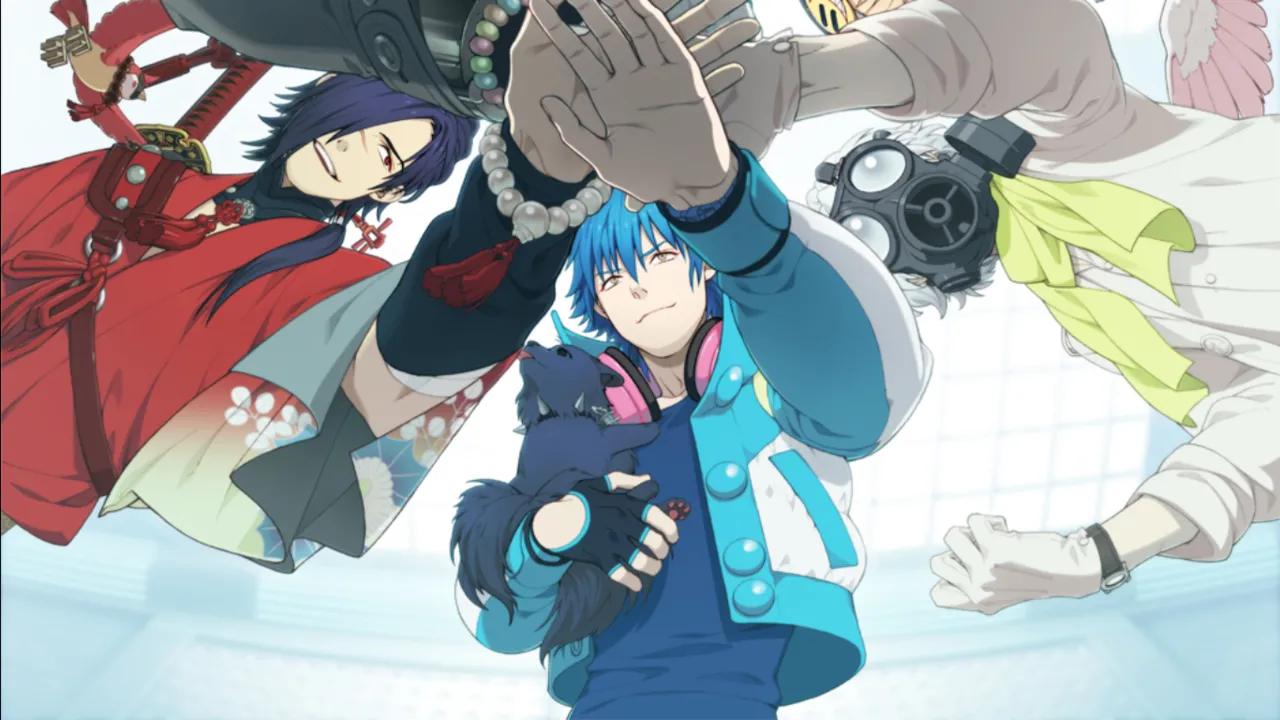
I mean, there’s the unavoidable scene with Mink's goons, but look at this! It’s so colorful. And all of the bachelors are friendly towards each other! It’s so wholesome!
I, personally, believe this is why DMMD is still the most popular Nitro+Chiral game, even as Slow Damage succeeds it as the company’s most recent release: DMMD is a proper dating VN, while Slow Damage is a linear thriller. Slow Damage does not have choices beyond an initial split between Taku and Rei. For the most part, it consists of a linear narrative with routes being unlocked as another is completed. You can still get violent bad endings, but there is a lot of violence hard-baked into the game with no way of avoiding it. You do not get to choose between a colorful entourage of cute boys who only turn evil if you force them to: the boys in Slow Damage all have some deep, inner adult turmoil that makes each of their routes a unique exercise in grimdark misery.
…I did start writing a Slow Damage blog because I found myself having too many criticisms of it. So many, in fact, that I couldn’t get through the game. I do mean to finish it someday. When I do, I’ll write a blog elaborating more on this.
The relevant point is—if you come into any other Nitro+Chiral game after playing DMMD, you’re going to be thrown for a loop, because DMMD is by far its most sanitized release. I, however, already knew what I was getting into when picking up a new Nitro+Chiral title. I knew it was going to be fujo goonerbait with a lot of noncon and hopefully an unique narrative.
I was not, however, expecting Sweet Pool to be one of the most poignant pieces of horror media I have ever consumed.
I knew two things about Sweet Pool before going into it: I knew it was too gross for my boyfriend to get through, and I knew it had a lot of guro. Guro is par for the course for Nitro+Chiral, as we discussed before, so I didn’t think much of it. I don’t particularly enjoy guro, but it doesn’t bother me—I wind up skipping through most of the g-scenes just to say I completed every ending.
“Guro” isn’t the word I would use to describe the viscera in Sweet Pool. It’s just gore. It is a horror game. The gore serves to amplify the horror—and, despite it being a BL game with sex scenes, the gore is, objectively, not sexual.
Sweet Pool is a high school love story that doesn’t have a happy ending. The love story it would be if it was written by anyone other than Kabura Fuuchi crumples under themes of religious trauma, queerphobia, and tokophobia.
It doesn’t pretend to be anything it’s not; the game immediately starts with blood and gore. Our protagonist, Youji Sakiyama, has never been like the rest of his peers. He’s always been sickly and frail, so much so that he’s having to repeat his most recent year of high school because he spent too much time in the hospital. He chalks it up to chronic illness, but within seconds of starting, it’s revealed to the player the truth: something is growing inside of Youji. Something alien, something sinful, and something terrifying.
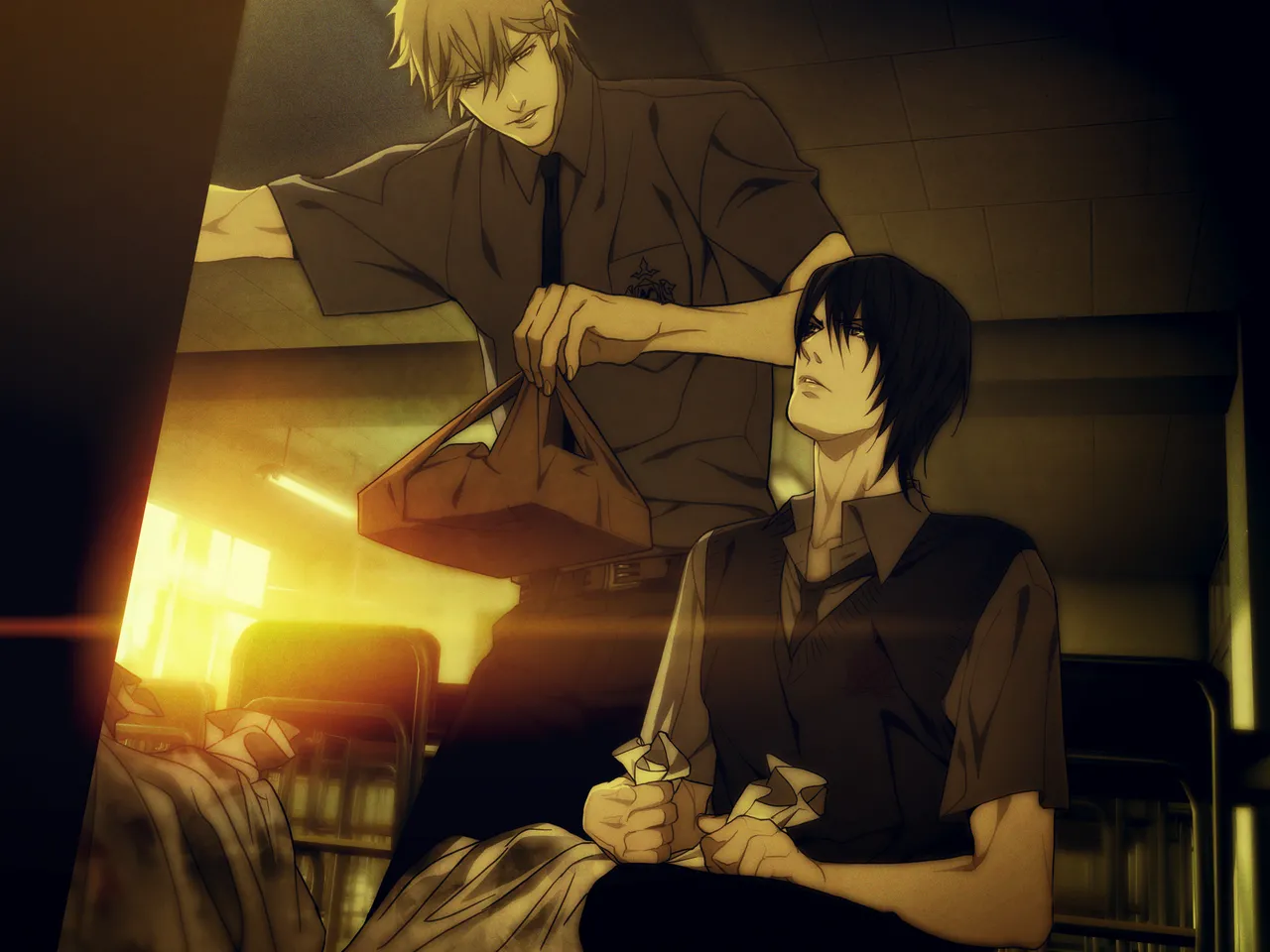
The art in this game is gorgeous. The colors are so sickly and disturbing, while also having the capability of seeming so deeply romantic at times.
I don’t think there’s much merit in recounting every event in the game—you’ve either played it yourself or you *should* play it yourself. This is not meant to be a professional review, but simply the rambling ravings of someone who very much enjoyed said game. My review is that, if you enjoy horror, you should go play it. Now. The rest of the blog will contain copious amounts of spoilers.
The mystery involving the creature inside of Youji forms the central throughline of the narrative that connects all of the separate endings. While Sweet Pool does feature “routes” with different “bachelors”, every ending of the game is a bad one—and each ending takes place chronologically after the others. In this way, Sweet Pool has a linear narrative: the Makoto ending picks up after the Zenya ending, the “first” Tetsuo ending takes place after the Makoto ending, etc.
In addition, you don’t make “choices” in Sweet Pool. Every “choice” in the game is between two options, instinct and reason. You don’t get a real sense of whose “route” you’re going down with each choice you make—mostly because, as said before, there aren’t really routes. If you make a certain wrong choice, you instantly unlock the Zenya ending—same with Makoto. Tetsuo’s is more complicated… but the point remains.
I’ve seen people criticize this aspect of the game. Personally, though, I don’t have a problem with it—and I actually think it makes the game feel even more immersive. Sweet Pool doesn’t play like a game: it reads like a book. The gameplay doesn’t have to be deep for the game to be good, because it’s not trying to be a game: it is, first and foremost, a scary story.
To complement this, Sweet Pool is the only visual novel I have ever played that is told in third person. Youji is indeed our protagonist, and for most of the game, we get glimpses into his thoughts—but it’s told in third-person limited perspective rather than first person. Occasionally, the game jumps to other perspectives, like Kitani’s or Makoto’s. This gives the game an novel-like feel. I am not Youji, but the game still manages to make me empathize with him.
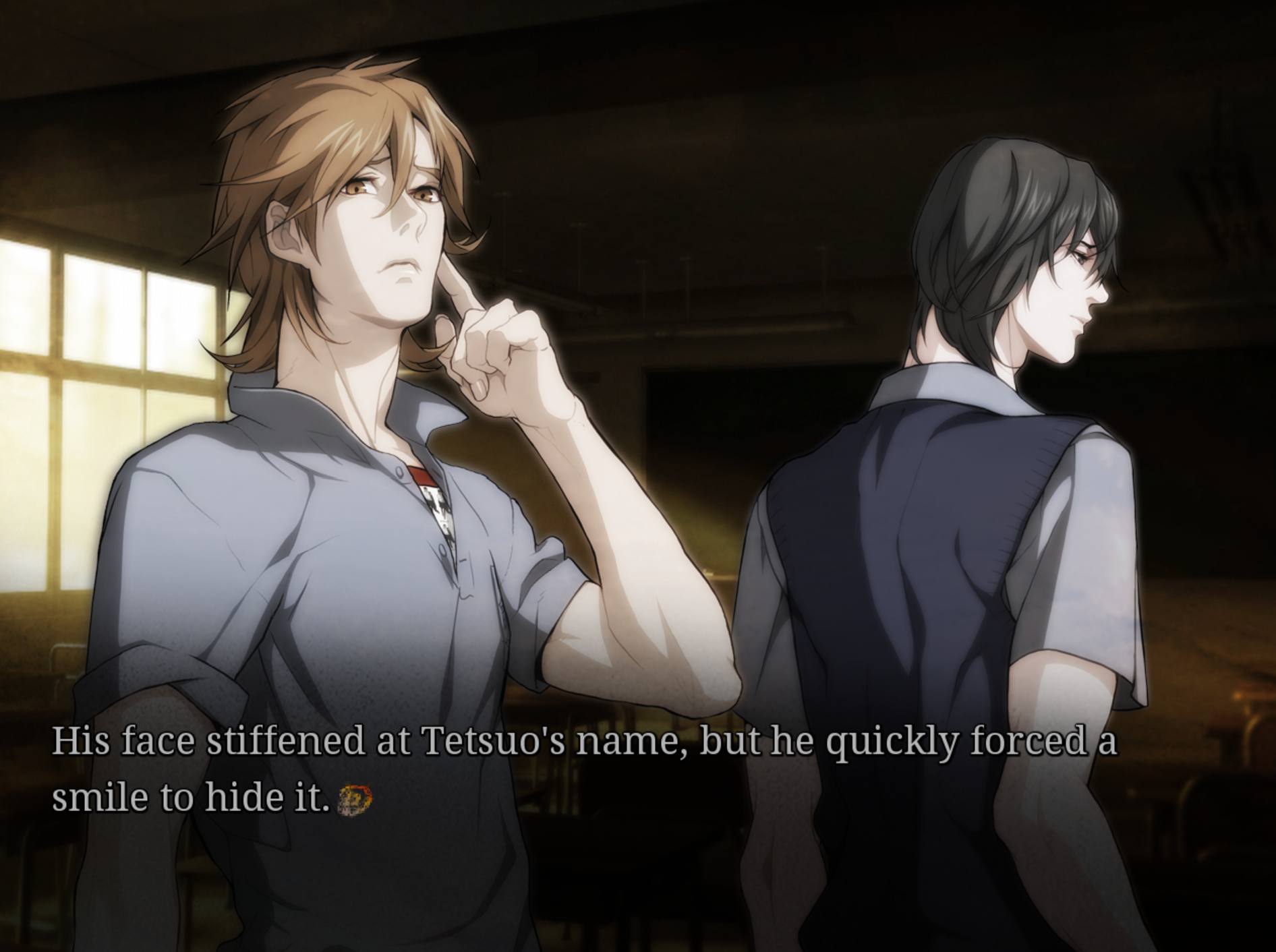
I also love how the sprite work is so dynamic. It makes the whole world feel alive and kinetic, in contrast to static, unbudging character stills in other games.
Sweet Pool is written concisely, too. It’s a short game, clocking in at only 13 hours—a miniscule value compared to Slow Damage’s 53. This doesn’t make the game lesser—in my opinion, it’s an improvement. So many VNs are bogged down by being too involved in their protagonist’s heads. Slow Damage has so many rambling lines of dialogue where Towa 1. gets out of bed, 2. smokes a cigarette, 3. comments on how bored he is, and then 4. goes back to bed. It’s so annoying.
You could argue that this is done so you feel like you’ve truly stepped into the life of someone completely different than you. I don’t agree. I think it’s bad, monotonous writing that exists solely to pad run-time. Sweet Pool was such a breath of fresh air because every line of dialogue, every description, feels like it has a purpose. It’s punchy. It’s brutal. When Youji mentions his childhood spent isolated from everyone except for his sister, it means something to me, because Youji is sparing with his reflections. What takes Youji two lines of dialogue to convey would take Towa, like, 102.
This aspect of the writing is especially poignant in the descriptions of the gore. When Youji is overcome by nausea and the fleshseeds birth from his asshole, it’s horrifying. The description is as clinical as much as it is vicious. Such few words are used to describe it that you’re able to hasten from one sentence to the next; you, too, feel overwhelmed and desperate to find out what happens next, just like Youji. The descriptions are not self-flagellating or sexual: they are curt and blunt. Youji is disgusted by this, and you are, too.
If this game is pitched to you as, “It’s about a guy who realizes he’s giving birth to monsters,” you’d probably think, “Ah. Fetish game. Got it.” I initially thought that way, too. The very first line of the game is from Genesis 1:28—Multiply and replenish the earth. Instead, though, Sweet Pool is a game that explores not only the cosmic horror of having your agency stripped away by an alien entity, but also the horror involved in childbirth, hormonal changes, and overall, the intrinsic horror of womanhood.
Youji is a Female. The organism inside of him, affecting his senses and clouding his judgement like a symbiont—is a Female, and it acts as a secondary gender (like… omegaverse, I guess, but with actual horror implications rather than horny goonerslop). Men are usually chosen for Females to possess as an act of sodomy against God: “They”—these spurned, fleshy organisms able to inhabit people’s bodies—are described as being an amalgamation of the people God spurned during Genesis’s Flood. “They” are without shape and form, and invisible to anyone who has not in some way consumed their flesh: they are writhing, fleshy chunks of pure despair, rage, and agony. The babies that Youji births immediately wither and suffer. They are the living dead.
Youji discovers he is a Female slowly over the course of the game. It starts first with nausea, bleeding. Strange, writhing lumps force their way out of him. The imagery of finding yourself nauseous in the school bathroom, bleeding from your most intimate place while struggling to understand what’s happening to you… it’s very reminiscent of a girl’s puberty.
I can’t tell you the number of times my period has been so awful that I’ve had to sprint to public toilets and cry into my hands as lumpy red viscera rips its way through me. It was at its worst when I was younger, and especially as it was just starting. And I was often left wondering: Why? Why is this happening to me? I don’t want a baby. Why am I being forced to go through this when I don’t want a baby?
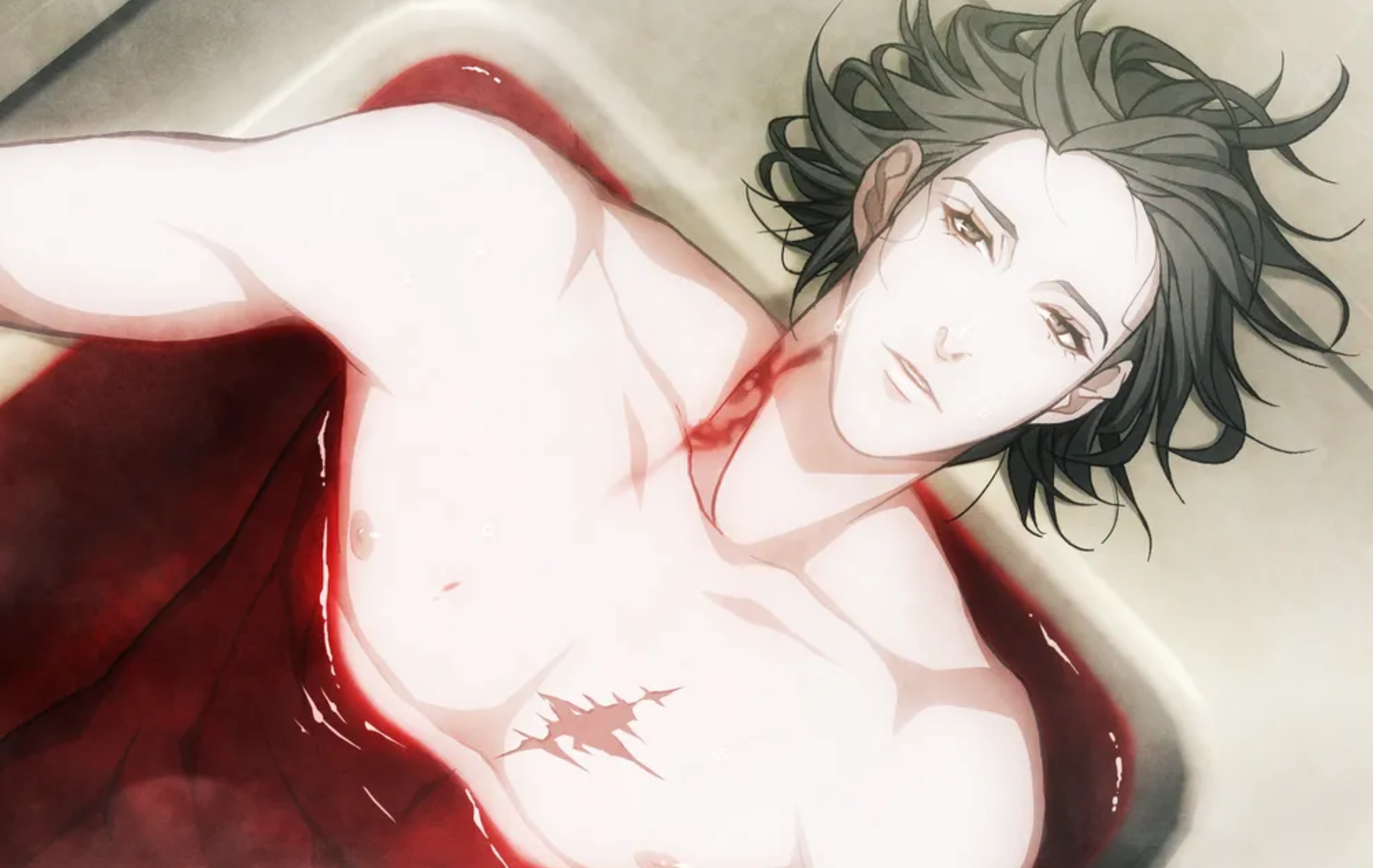
I too have spent prolonged hours writhing in a bathtub filling up with period blood I MEAN UH. KOOL AID. THIS IS KOOL AID
But I had no choice. Fate and genetics decided that this was my role in life. Plead as I might with the powers that be, nothing can change the fact that I was born to bear children. My entire anatomy is dedicated to it, my hormones and brain chemistry is structured around it—and, occasionally, it causes me so much terrible pain that I vomit and cry.
As Youji develops through his “adolescence”, he occasionally checks in with his sister. His sister, as far as the story lets us know, is normal—and she just recently had her first child. She’s as delighted as can be. Youji tries to be happy for her, but every reminder of her joy reminds him of his own misery. His sister has a healthy, normal baby. He gives birth to wriggling maggots of flesh. He will never have her happiness. He puts on a happy face for his sister, then hangs up the phone and sobs; not only does he not want to infringe upon her happiness by bothering her with his troubles, but the direct parallel between her offspring and his demonstrates just how dire his situation is.
The contrast between Youji’s relationship with his inner being and Zenya’s is especially interesting. For Youji, his puberty comes on suddenly, and he stumbles through it without ever coming to a real understanding of what is happening to him. Zenya, on the other hand, has been raised with the understanding that his only purpose in life is to serve “Them”. His body was corrupted by his father in an attempt to make Zenya produce perfect offspring… but he failed. Zenya will never be able to bear children.
He, too, suffers through horrible, bloody pain—every day at 5pm. He resents the religion of his father and wants to be more than a broodmare. And yet, at the same time, he is drawn to Youji and wants to claim him as his own. If he can mate with Youji and produce genuine offspring, then he will be validated by his cultish community. His value is solely defined by his ability to give birth to healthy children.
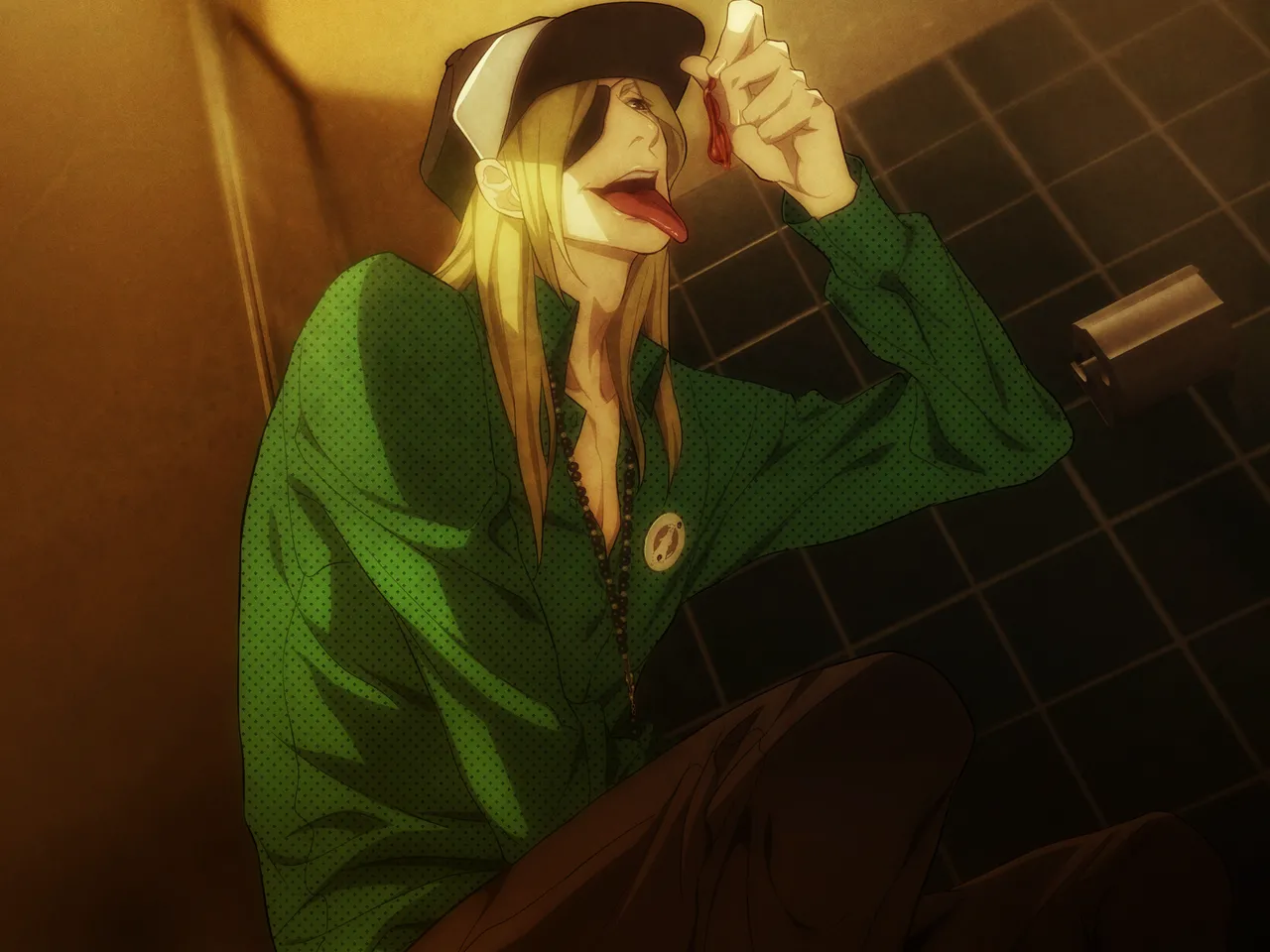
I’m a sucker for a snake-themed character.
Zenya deals with this through dissociation and derealization. At the end of the day, though, as his guts spill out of his stomach from a knife wound, he remarks to Kitani, his retainer, that he’s finally happy to have birthed a healthy baby. He looks at his own intestines and sees them pulsing with life in a way his fleshseeds never had—and he’s happy. In his final moments, the only way Zenya can achieve true joy is by deluding himself into thinking he fulfilled his purpose after all.
It’s horrific. And yet, it is not an uncommon narrative we hear from women in real life. So many communities, especially religious ones, value little about a woman other than their ability to reproduce. They can be smart or funny or creative, but none of their accomplishments will ever matter as much as having a child. When they have a child, nobody cares any more about their degree or their promotion. If they don’t have a child, people scoff at accomplishments: “Does it really matter if you’re not a mother and don’t have a child to share your joy with?”
Sweet Pool explores the horror that every woman experiences on a daily basis by forcing womanhood onto unexpecting men. When a man experiences these traumas, we’re made to interpret them as grotesque, incomprehensible horror—but this is just being a woman.
One of my favorite routes is Makoto’s, and it’s the one I got first (I always play a VN blind, then use a guide to get the rest of the endings). Makoto sees Youji as a friend, but they’ve both kept one another at arm’s length for a while. And yet, when Youji begins to go through this puberty, Makoto starts seeing him differently. He grows obsessed with him. He lashes out at people who interact with Youji, and he becomes desperate for Youji’s approval and affection.
It’s reminiscent of when young girls mature into preteen adolescents and suddenly, all of the men in their life start treating them differently. Men and boys—we teach little girls lessons like, “You can’t wear those shorts. They’re too short, and they’ll distract the boys.” Or, “You can’t wear spaghetti straps—they show too much skin. If you were that in public and something happens to you… it’ll be your own fault.” I vividly remember one of my male high school teachers taking a ruler to every girls’ shorts to determine how long they were and if they needed to be sent to the nurse’s office to wear something else. How utterly disgusting for a grown man to leer at young girls like that, to teach every boy in that class that it’s the girls’ fault for dressing too provocatively, too distractingly, and that it wouldn’t be their fault if the girls’ shorts provoked them into doing something.
Makoto no longer sees Youji as an equal, but as something he can possess and consume. Unlike the other two routes, he doesn’t know anything about inner beings—he simply wakes up one day and starts seeing Youji as a piece of meat he wants to fuck and eat. He deals with gay panic and feels disgusted with these new feelings… but his obsession with Youji eclipses all sense. And, in his ending, this is taken to the most dramatic of extremes: he takes Youji for himself and cannibalizes him.
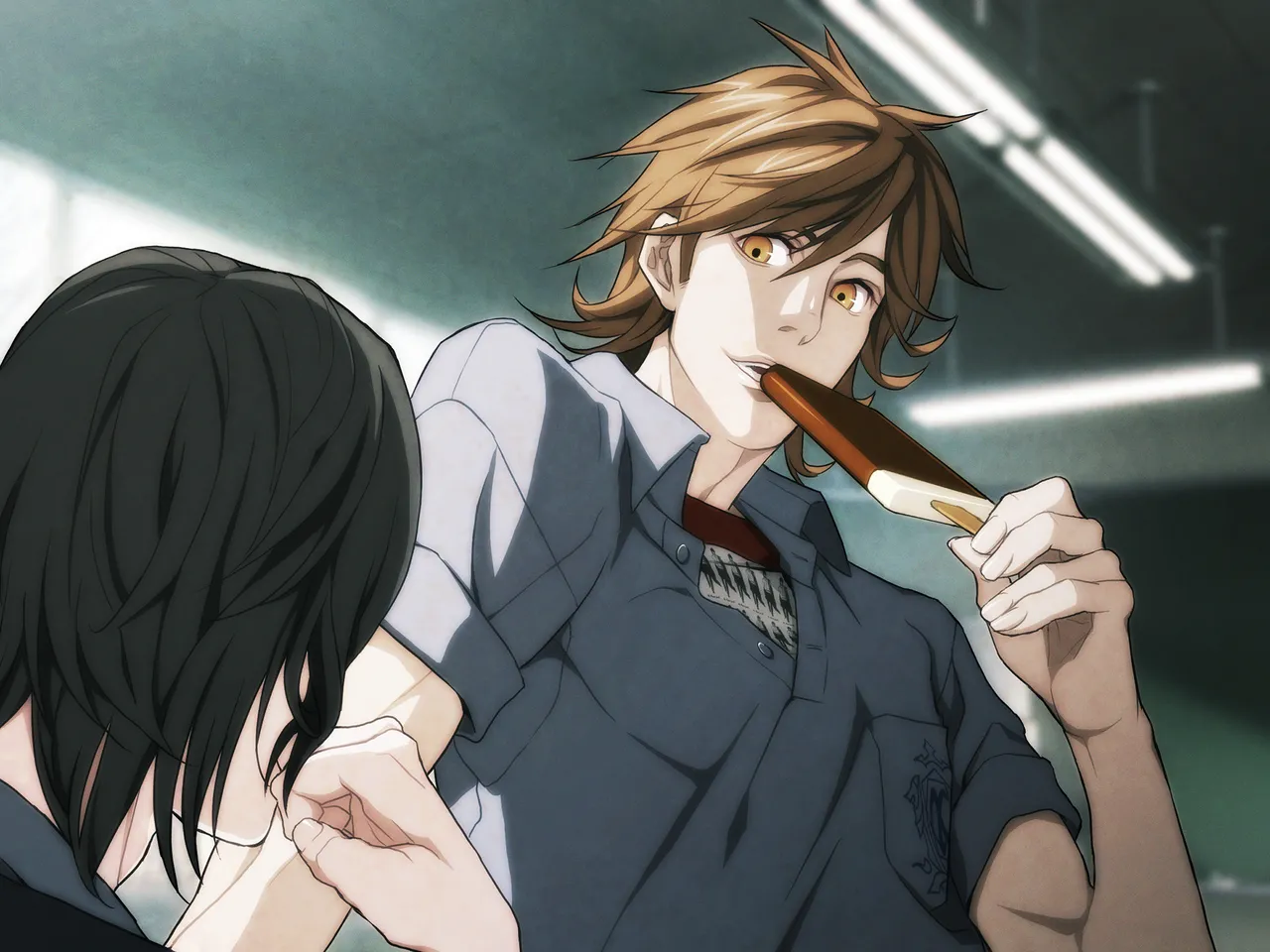
The SECOND I saw this guy with his little ice cream cone I was like, “Oh, this guy is gonna eat me.” Vindication.
This moment struck me hard. I, too, have lived through an adolescence where people suddenly started seeing me differently. One day, I was no longer an equal: I was lesser. I was something to be ogled at. I was nothing more than my assigned sex. This route reflects the horrors I had experienced and amplifies them to a visceral, unsettling degree.
Then there’s Tetsuo. Tetsuo has multiple routes, and at least one of them can probably be considered the true ending. Like Youji, Tetsuo has an organism inside of him, but his is Male—and if he and Youji were to mate, they would be able to produce a perfect offspring capable of spreading the symbiont to even more people.
While the horror in Makoto’s ending I read as invoking the horrors of womanhood, Tetsuo’s reminds me more of queer horror.
Tetsuo is naturally attracted to Youji because his symbiont is Male, and he is, in general, a Perfect Male. Their bodies are compatible, and thus they are drawn to each other by some strange, cosmic pheromone. Youji resents this; he doesn’t understand why he feels so attracted to this man, and why this man continues to engage in sexual acts with him despite neither of them particularly wanting it.
Youji and Tetsuo are both socially inept. Youji is more quiet and wallflower-y, while Tetsuo is a silent, lone-wolf type. Youji tries to deny the pull by fleeing from Tetsuo, while Tetsuo refuses to acknowledge Youji as a human and instead only sees him as the symbiont—because he, himself, has learned to believe that he is not human. This, to me, reads as two separate versions of dealing with queer panic: a flight or fight response. Youji tries to reject his queerness in an attempt to keep his humanity, while Tetsuo embraces it with the understanding that it makes him inhuman.
As the two grow closer, they recognize both the monstrosity and humanity within each of their psyches. Youji brings out a gentleness in Tetsuo he didn’t know he had, and Tetsuo unleashes a hunger in Youji he had long tried to suppress. And, through this, they fall in love; whether or not they consummate their love by courting their inner monster or saving their inner human is up to the player. The narrative does not account for a middle ground between instinct or reason—monstrosity or humanity—and it therefore does not provide a happy ending. No matter how you play, Tetsuo and Youji will never have a normal love story. The two of them confess their feelings on the school roof while holding hands—a sure sign of a romantic ending in any other VN—and then are tragically killed, no matter which ending is achieved. They cannot have a true romance because they are both monsters. They are both queer. Even were they to embrace that monstrosity, it results in the two of them transforming into something unrecognizable—a beautiful messiah, a harbinger of doom to spread this sour, queer illness to countless other victims.
It does not paint a kind nor gentle image of queerness. I don’t think it has to—it’s a horror scenario. While I know the lead writer is a woman, I do not know if she is a straight woman, and I don’t know if this portrayal of queerness comes from internalized queerphobia or something else. I don’t claim that my personal reading of the text is the canonical opinion of the author, and I don’t really care. This is just how I choose to read the narrative: a frightening portrayal of one’s internal queerphobia, written as a literal writhing monster inside of you—forced there by your fucked up genetics, nursed by fucked-up perverted zealots—that will never allow you to be happy lest you sacrifice yourself to defeat it.
Interestingly, Tetsuo and Youji do not grow closer of their own volition. The main “villain” of the game is Kamiya, their chemistry teacher and one of the worshippers of “Them”. His slow, snake-like integration into the narrative is brilliantly written: he starts off as a background character without a name who puts Tetsuo and Youji on cleaning duty together. Then he’s given a name, then a sprite, as he continues to force the two of them into close-quarters: asking Tetsuo to bring Youji to the nurse’s office, asking them to drop off each other’s homework, etc. You don’t realize he’s malicious until a ways into the narrative, when the characters themselves start picking up on his odd behavior enough to deign to acknowledge him by name.
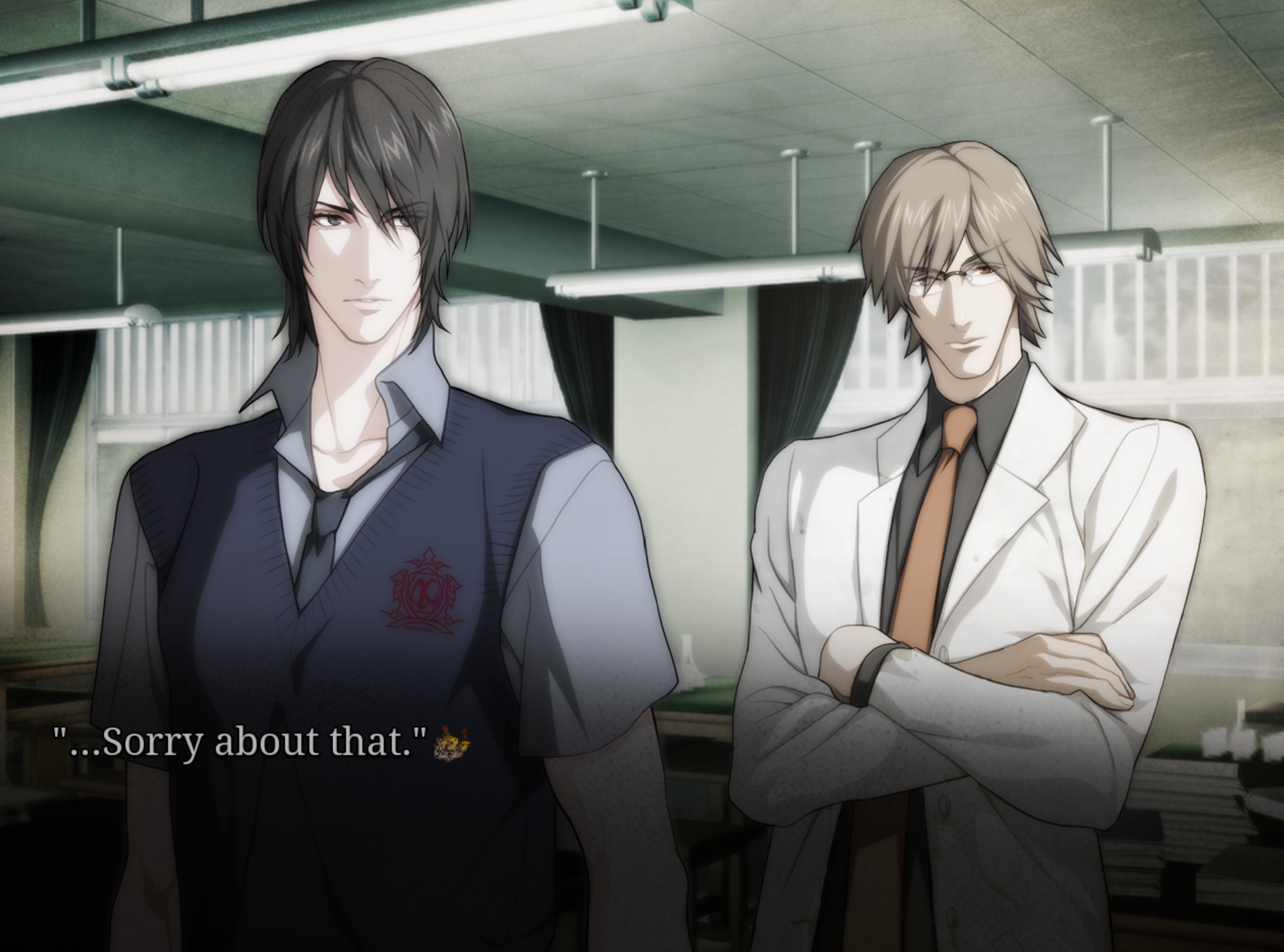
As soon as he got a sprite I was like, oh yeah. He’s a bad guy. You can't trust a man with glasses in a N+C game.
It’s Kamiya’s goal to get Youji and Tetsuo to breed in order to create a “chosen one”—a “messiah” figure that will be able to produce perfect offspring and feed that offspring to its followers, thus spreading the symbiont across the globe. This happens in the ending where Youji gives into his instinct/monstrosity: the two fuck, and then merge into each other within a horrific cocoon of flesh before it shucks away to reveal a perfectly beautiful little boy with crimson eyes.
The religious nature of the order lends this entire aspect of the plot an edge of Christian guilt. I think that these “inner beings” are very interesting in their relationship to queerness—they specifically choose men to inhabit so their union is sodomy, an insult to the God that smote them into these disgusting creatures forced to rot in the shadows. Kamiya and the order resent God and want to usher in a world where those He betrayed regain their proper form… would this not theoretically be a queer reality? One that celebrates what God and His followers would denote as “sinful” acts?
You could read Kamiya’s involvement with Tetsuo and Youji as a form of grooming—maybe even that loathed “queer grooming” right wing media likes to pretend exists en-masse. I, personally, would instead say that Kamiya demands of Tetsuo and Youji a stance on an ancient issue that doesn’t concern them. Kamiya represents the inherent politicism of queerness, the idea that being queer is a stance against God and society, and that in order for you to thrive as queer, you have to act on an unwavering vendetta against the preestablished order. You are not allowed to be happy or normal—you have to recognize that you are a miserable, disgusting monster, and only by reveling in your ungodliness can you be allowed to persist.
Tetsuo and Youji didn’t ask to be a part of this ancient war. They’re just two boys who happen to be in love. All they want to do is hold hands on the school roof, like any other couple in any other romance game. Their humanity says they can’t have happiness because they’re queer (and queer people are monsters, so they deserve to die). Their monstrosity says they can’t have happiness because they’re queer (and queer people are monsters, so they have to fight and gnash their teeth until they’re put down by God).
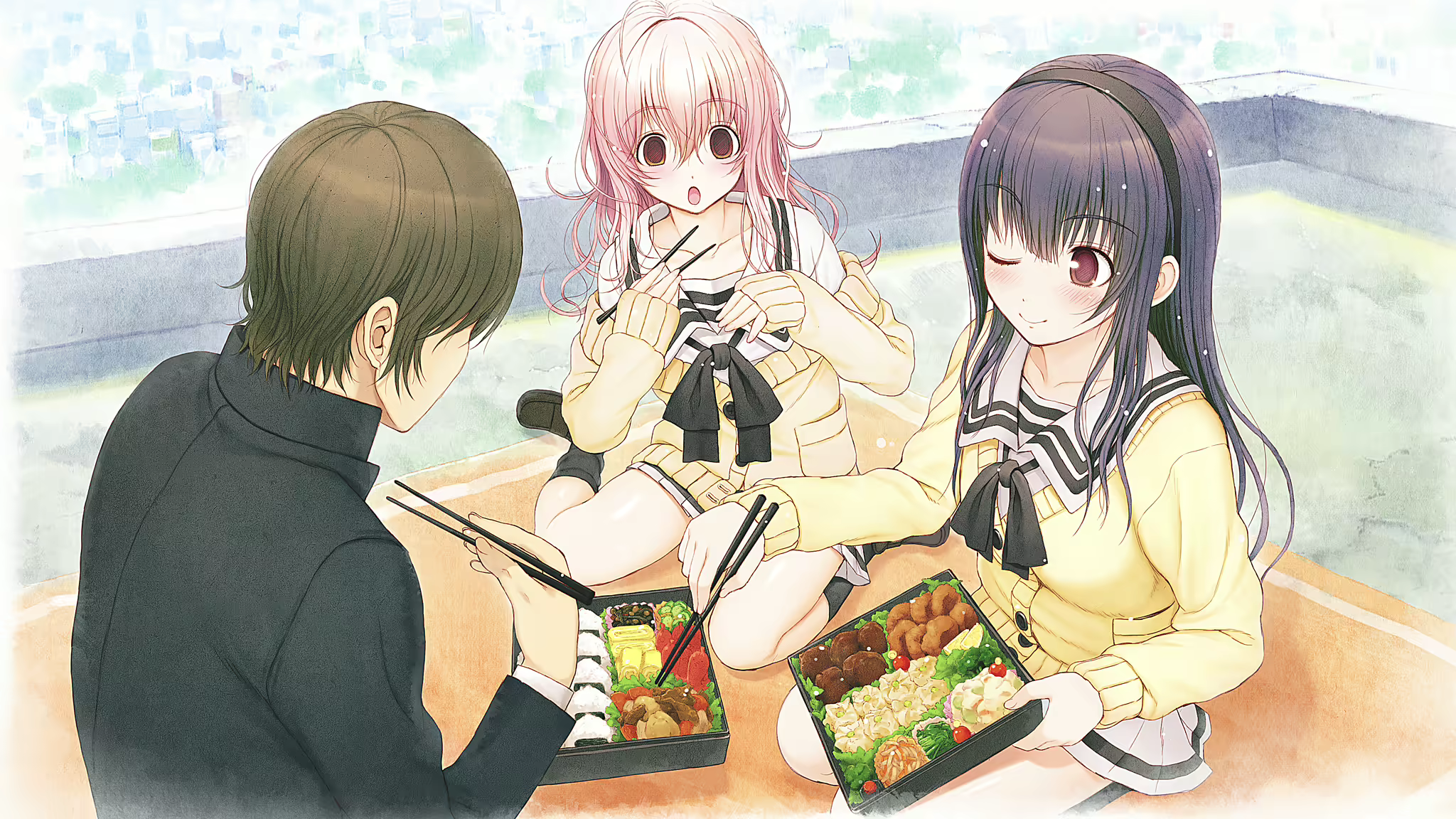
YOU and ME and HER: A Love Story, another Nitroplus deconstruction of romance VNs, also features a school roof as the setting for most of its crucial events.
Queerness and its wider acceptance by society is a complicated issue—a frightening issue. The game invokes the fear queer kids have being born into such a violent world. They don’t deserve to be martyrs of the left or victims of the right. They deserve to be kids. Sweet Pool plays up this horrific fear—the fear that you as a queer person can never be happy—to a delicious, disgusting eleven.
Man. I haven’t even talked about how much I love the B plot with Kitani. I’ve never seen a B-plot done like this in any VN, especially not an eroge. The game’s narrative is a roughly 70-30 split between Youji uncovering aspects about his sickness and Kitani, the loyal retainer for Zenya’s yakuza family, investigating his boss’s strange new religion. Yakuza politics feature in almost all of Nitro+Chiral’s games, but never as a POV. It turns Sweet Pool into even more of a horror-thriller with mysteries actively being solved.
I especially love how the two stories beautifully intertwine at the climax. Kitani owes everything to his boss, and he loves Zenya deeply while also resenting the fact that he has thus far been unable to understand the horror he’s been subjected to. He finally begins to comprehend the nature of these “inner beings” through his own snooping and investigating… but by the time he figures it out, it’s too late. Zenya and his father, in a fit of desperation, attempt to kill Youji in order to elevate Zenya to a proper broodmother… and they fail. Zenya dies, and Kitani cradles him in his arms.
You feel for both POVs here. You feel for Youji: Youji never once asked for this. He just wants a normal life. Kitani thinks, so did Zenya. Why should Youji get to have a normal life when Zenya couldn’t? He’s bitter. (He wants to continue the cycle of suffering. Queer people don’t deserve to be happy… because queer people of the past weren’t allowed to be happy. I had to suffer, so you must suffer, too.)
So, when he catches Youji and Tetsuo on the roof… he kills them. In some endings, at least… he at least always metaphorically kills their attempts at happiness. There’s one ending where he lets them go, only to follow them back to their apartment and kill them there—or come in just in time to witness their metamorphosis. The latter ending I think is especially interesting, because it implies that Kitani takes the child—the spitting image of what Zenya wanted to become—and raises it, presumably continuing the cycle of abuse. In another ending, Kitani shoots both of them, and they plunge into the pool below the roof together.
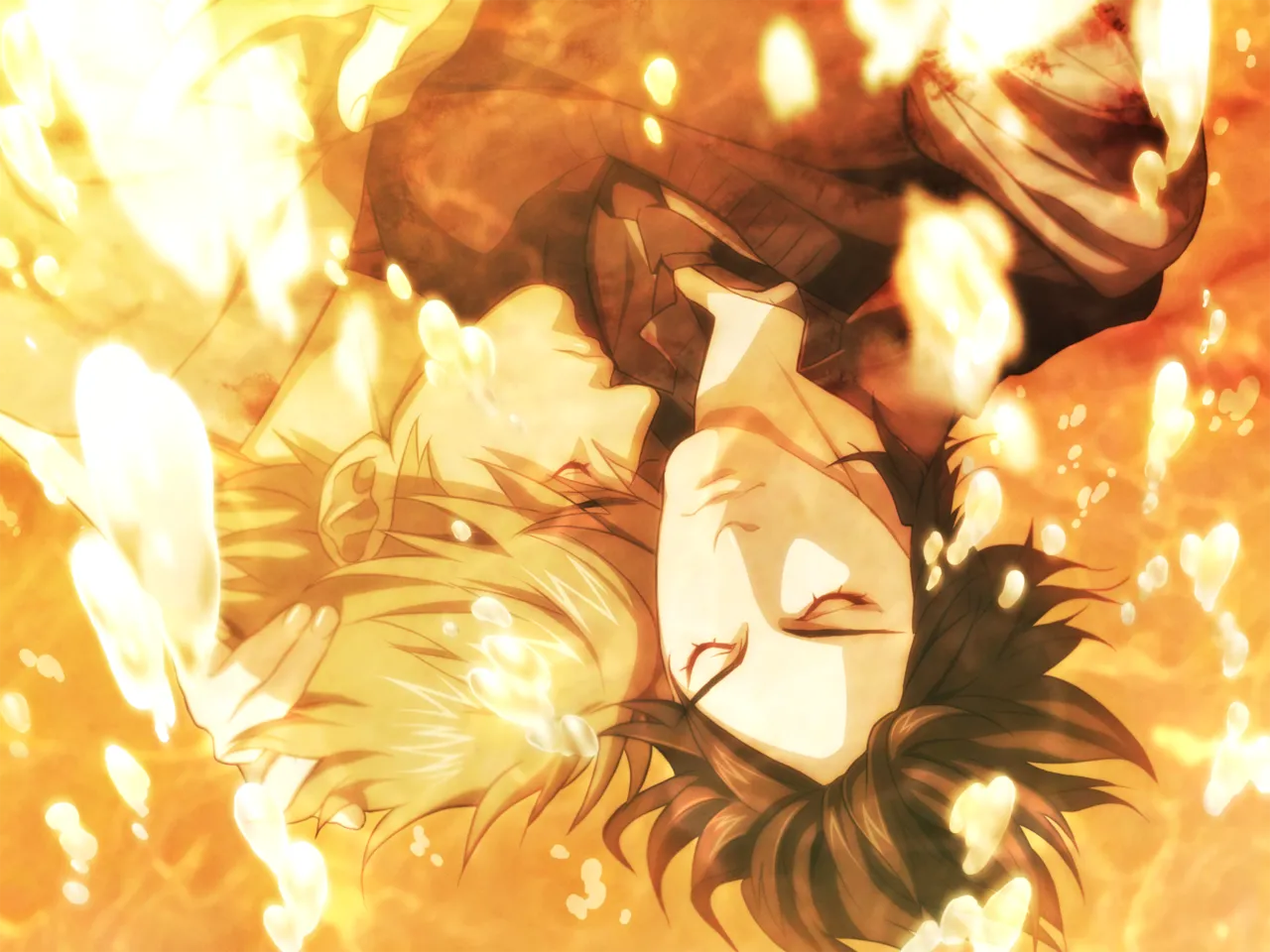
idk what the pool represents tho, and I swear the fact that there was a pool below the roof was never mentioned. is it like. the water of the womb??? representing being reborn??? uh
In one of these “sweet pool” endings, Youji sacrifices his “human” essence to save Tetsuo. Tetsuo is allowed to live a happy, fulfilled life… while being forced to keep the shriveled, fleshy symbiont of Youji sequestered from the world. He’s forced to watch as Youji slowly dies, and they never get to consummate their love or pursue a life together. Youji is a repulsive secret that Tetsuo is forced to keep until Youji eventually succumbs to his misery.
In the other, presumably “true” ending, Youji is able to call upon his instinct. I read this ending as Youji somehow managing to expel both his and Tetsuo’s inner beings, so—when they are both recovered—they are now normal humans, safe from the monsters that used to haunt them. However, in so doing… both Tetsuo and Youji forget each other. Their symbionts were a part of them—they might very well be the reason why the two of them fell in love. Without them, their memory of each other fades into little more than a dream, like a passing crush squashed by fear and phobia. The monsters represented their sin and their queerness. The two boys are able to go on living their life… but they will always feel empty, like something is missing. A part of them had to die in order for them to have a shot at a normal life.
I’ve read a lot of complaints about this true ending—it’s boring, it’s dumb, it’s sad. However, I think it’s miserably perfect. The horror of Sweet Pool posits that queer people are not allowed to have a happy ending. In order for Tetsuo and Youji to live their lives, they must banish their queerness… but is living as something false really “living”? Are they still not capable of being happy—even after giving up the thing responsible for their misery? They aren’t. There’s no happy ending. They were doomed from the start—and that’s what makes Sweet Pool truly terrifying.
As a rule, I am not scared of horror games. Jumpscares will make me yelp, sure, but I view them the same way I view scare actors in a haunted house: they’re there to do a job, and when the scare is over, I can laugh and compliment them on a job well done. I can feel tense in a video game, but only in the sense that if something ~oogla-booglas~ and kills me, I’m going to have to repeat 30 minutes of walking, and that’s no fun at all. I love Resident Evil, but it doesn’t scare me.
I do, however, get scared by real accounts of crime. Real manifestations of evil and terror are what keep me up at night. Horror games—ghosts, demons, zombies, monsters—aren’t real, so they’re not scary. It’s fiction. It’s made up. Reality is far more terrifying because I can’t tell myself it’s just a scary story.
Sweet Pool is the only game I have ever played that has genuinely unsettled me. It didn’t make me jump or scream, but the feeling of chilling unease it left me with after every play session wriggled under my skin and into my brain… and I think it’s because that, in some part, the horror of Sweet Pool is real. I’ve lived it. So many women have lived through it. So many queer people have lived through it. It’s an uncomfortable reflection of the worst parts of our society and species. It preys on my biggest fear: that as an AFAB queer person, I am not allowed to have a happy ending. And that’s terrifying.
I am so bitter that Sweet Pool will never get the recognition it deserves because it’s a BL game. There’s gay sex in it. The gay sex is intrinsically important to the narrative; the horror is gutted without it. There is a “SFW” version on Steam, but I haven’t played it, and I’m not interested in playing it. It honestly offends me that it has to exist—that we as a society are fine with showing images of undulating flesh and blood, but not a penis. The queer love story of Sweet Pool—its most innocent attribute—is the “problematic” aspect that requires censorship, not its intense violence. I suppose it goes to show that queer people are monsters that need to hide in the shadows, eh?
Even despite its uncanny reflection of our morbid reality, Sweet Pool is still just a story. Scary stories can get us to confront our fears—to admit shame and do battle with the most vulnerable parts of our psyche. And, as a scary story, Sweet Pool is fantastic. It’s the best horror game I’ve ever played, and I encourage you to give it a shot, too.

Yes, even with the gay sex.